Author: Micheal Brown

  • Best Desk Lamps for Video Calls and Eye Comfort

    Best Desk Lamps for Video Calls and Eye Comfort

    Find the best desk lamp for video calls and eye comfort with dimming, color temperature tips, glare control, and small home office setup advice.

    A good desk lamp can make your home office feel calmer, help your face look clearer on video calls, and reduce the harsh screen glare that builds up during long work sessions. The best desk lamp is not always the brightest lamp. It is usually the one that gives you adjustable, diffused light you can place slightly off to the side of your screen.

    Affiliate disclosure: As an Amazon Associate, I may earn from qualifying purchases. This does not change the price you pay, and it helps support Intuit Chaos.

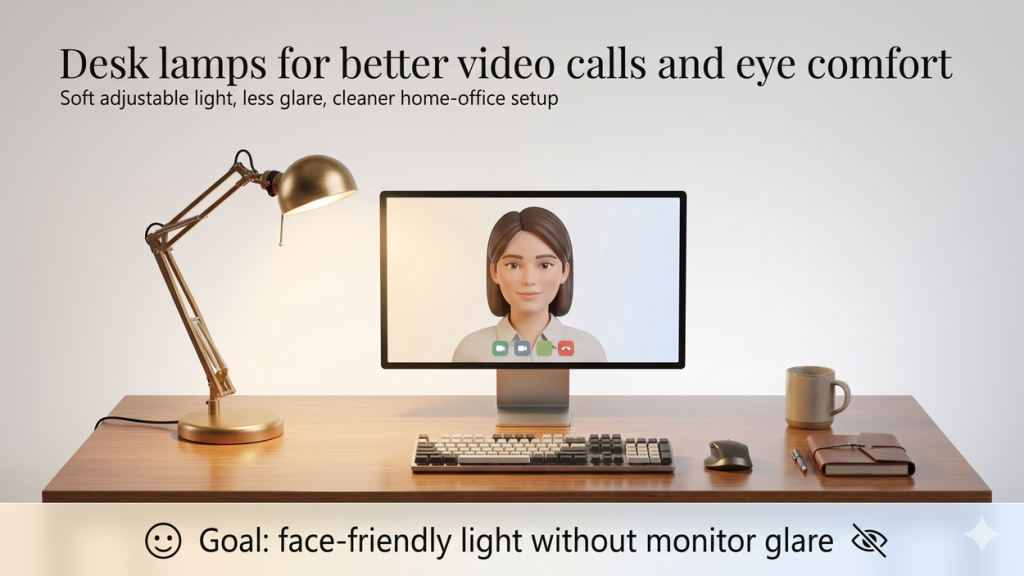
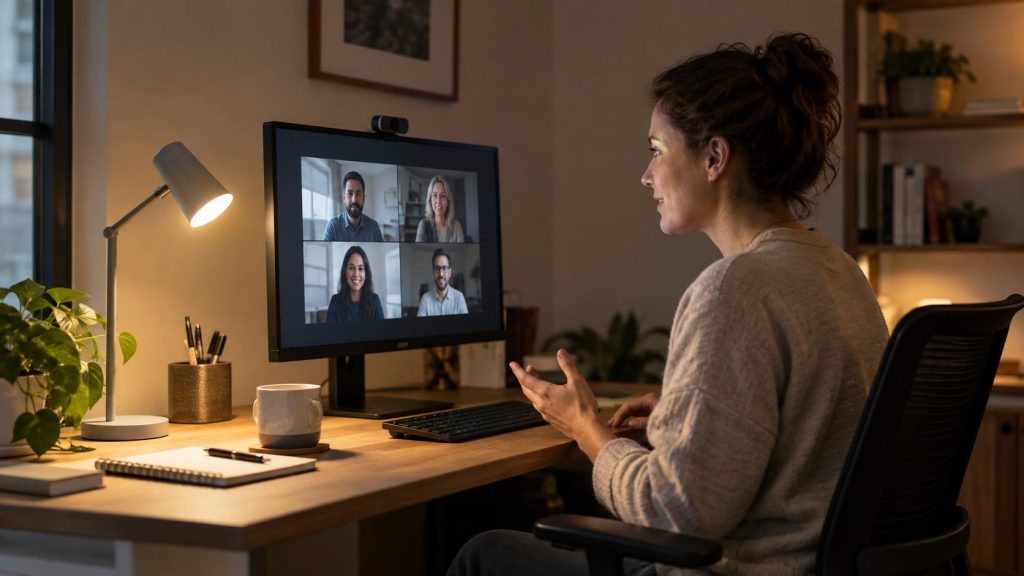
    Desk lamp setup for better video calls and eye comfort

    Quick Picks: Which Desk Lamp Type Should You Choose?

    If you want the simplest answer, start with the problem you are trying to fix.

    Need Best lamp type Why it helps
    Better video calls Adjustable LED desk lamp with dimmer Lets you soften face shadows without flooding the whole room
    Small desk Clamp desk lamp Saves surface space and is easier to position
    Less monitor glare Side-positioned lamp or monitor light bar Keeps direct light out of your eyes and screen
    Reading and late work Warm dimmable lamp Feels more comfortable in the evening

    For a broad starting point, you can browse desk lamps for video calls and eye comfort on Amazon.

    Why Lighting Matters for Video Calls and Eye Comfort

    Most home office lighting problems come from uneven light. A bright ceiling light can make your face look flat. A window behind you can make your camera darken your face. A lamp pointed straight at the monitor can create glare that makes your eyes work harder.

    A good desk lamp solves these problems by giving you control. You can move the light, lower the brightness, warm the color, or angle the lamp away from the screen. That control matters more than buying the most powerful lamp available.

    What to Look For in a Desk Lamp for Video Calls

    1. Adjustable Brightness

    Choose a lamp with several brightness levels or smooth dimming. Video calls usually need less light than people expect. If the lamp is too bright, your face can look washed out, and the room can feel uncomfortable during long calls.

    A dimmer is especially useful if your room changes throughout the day. Morning window light, afternoon shade, and evening darkness all need different settings.

    2. Color Temperature Modes

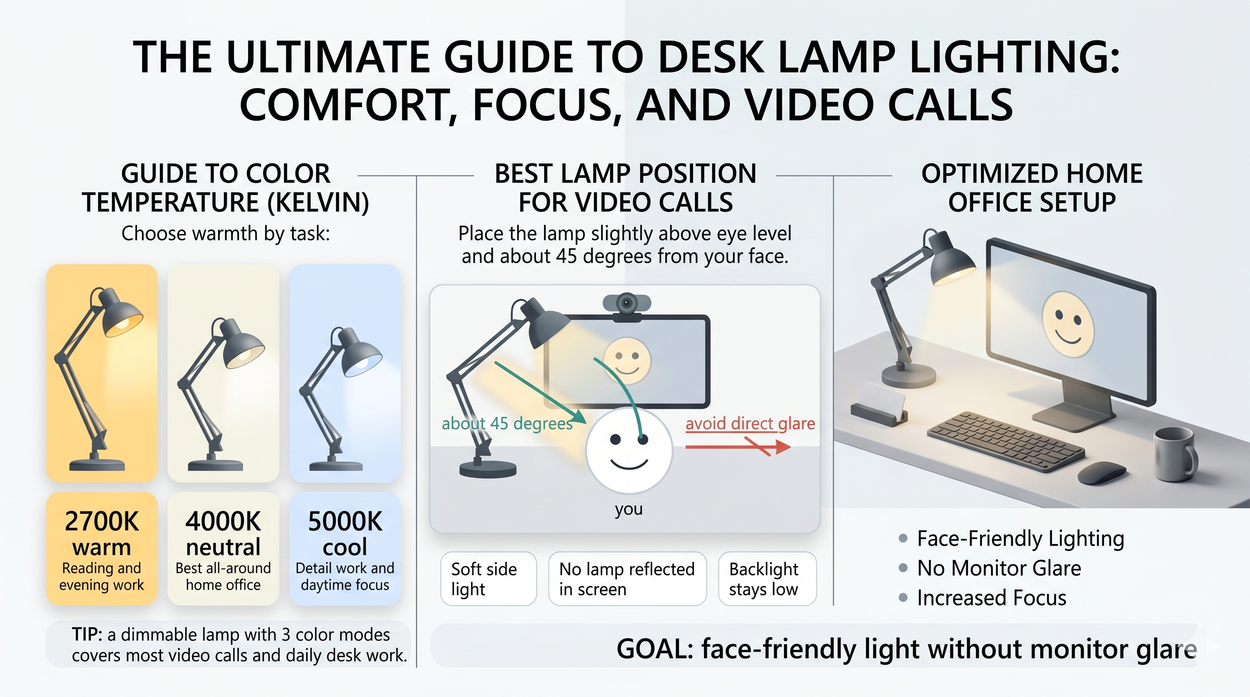
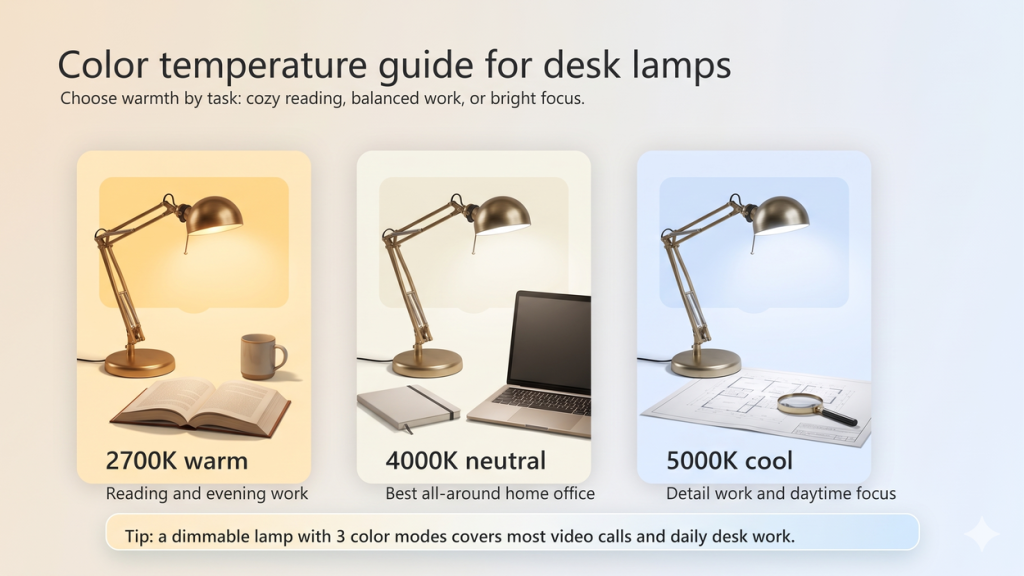
    Many LED desk lamps offer warm, neutral, and cool settings. Neutral light around the middle range is usually easiest for daily work and video calls. Warm light feels better for reading at night. Cool light can help with detail work, but it may feel harsh if used too late.

    Desk lamp color temperature guide for warm neutral and cool light

    If you only buy one lamp, look for a dimmable model with at least three color modes. You can compare options here: adjustable LED desk lamps with dimmers on Amazon.

    3. Diffused Light Instead of Bare Bright LEDs

    For eye comfort, diffused light is usually better than a small exposed bulb. Diffusion spreads the light across a wider surface, which helps reduce sharp reflections on your monitor and harsh shadows on your face.

    Look for lamp heads that use a frosted panel, wide light bar, or shaded design. If the product photo shows individual bright LED dots, it may feel sharper unless the lamp has a good diffuser.

    4. Flexible Arm and Stable Positioning

    Positioning is the secret feature. A lamp that cannot move much may force you to choose between glare, shadows, or wasted desk space. A flexible arm, pivoting head, or clamp base gives you more control.

    Clamp lamps are especially useful for compact desks. They leave room for notebooks, keyboards, and accessories. If your workspace is tight, see this related guide: Best Monitor Stands With Storage for Small Desks.

    Best Placement for Video Calls

    Place the lamp slightly above eye level and about 45 degrees from your face. This usually gives a natural look without shining directly into your eyes. If your lamp is on the same side as a window, lower the brightness so one side of your face is not too bright.

    Desk lamp placement diagram showing side light for video calls

    Try not to aim the lamp at the monitor. If you can see the lamp reflected on the screen, move it to the side, raise it slightly, or reduce the brightness. The goal is soft side light, not a spotlight.

    Desk Lamp vs Ring Light for Home Office Calls

    A ring light can make video calls look brighter, but it is not always the best everyday desk solution. Ring lights are built mainly for camera-facing light. Desk lamps are more useful for mixed work: video calls, reading, writing, planning, and general desk tasks.

    If you make videos or take frequent client calls, a small soft panel or ring light can be helpful. But for most people, a flexible LED desk lamp is easier to live with because it works even when the camera is off.

    When a Monitor Light Bar Makes Sense

    A monitor light bar can be useful when your desk is very small or you want light on your keyboard without taking desk space. It sits on top of the monitor and points downward. The best ones are designed to reduce screen glare, but placement still matters.

    If you often work at night and hate clutter, you can compare monitor light bars for home offices on Amazon. If you want more setup ideas, read Top 10 Home Office and Smart Home Upgrades for 2026.

    Best Desk Lamp Features Worth Paying For

    • Dimming: Useful every day, especially for calls and evening work.
    • Color temperature control: Helps one lamp work for reading, calls, and focus tasks.
    • Adjustable arm: Makes it easier to avoid glare.
    • Clamp base: Great for small desks and clean layouts.
    • Memory setting: Saves your favorite brightness and color mode.
    • USB port: Nice to have, but not essential.

    For tight desks, a clamp desk lamp for home office use is often the most practical option.

    Simple Setup Checklist

    1. Put the lamp slightly to the side of your monitor.
    2. Raise the light above eye level if possible.
    3. Start with medium brightness, then lower it until your eyes feel relaxed.
    4. Use neutral light for work and warm light for evenings.
    5. Check your video preview before calls and adjust the lamp angle.
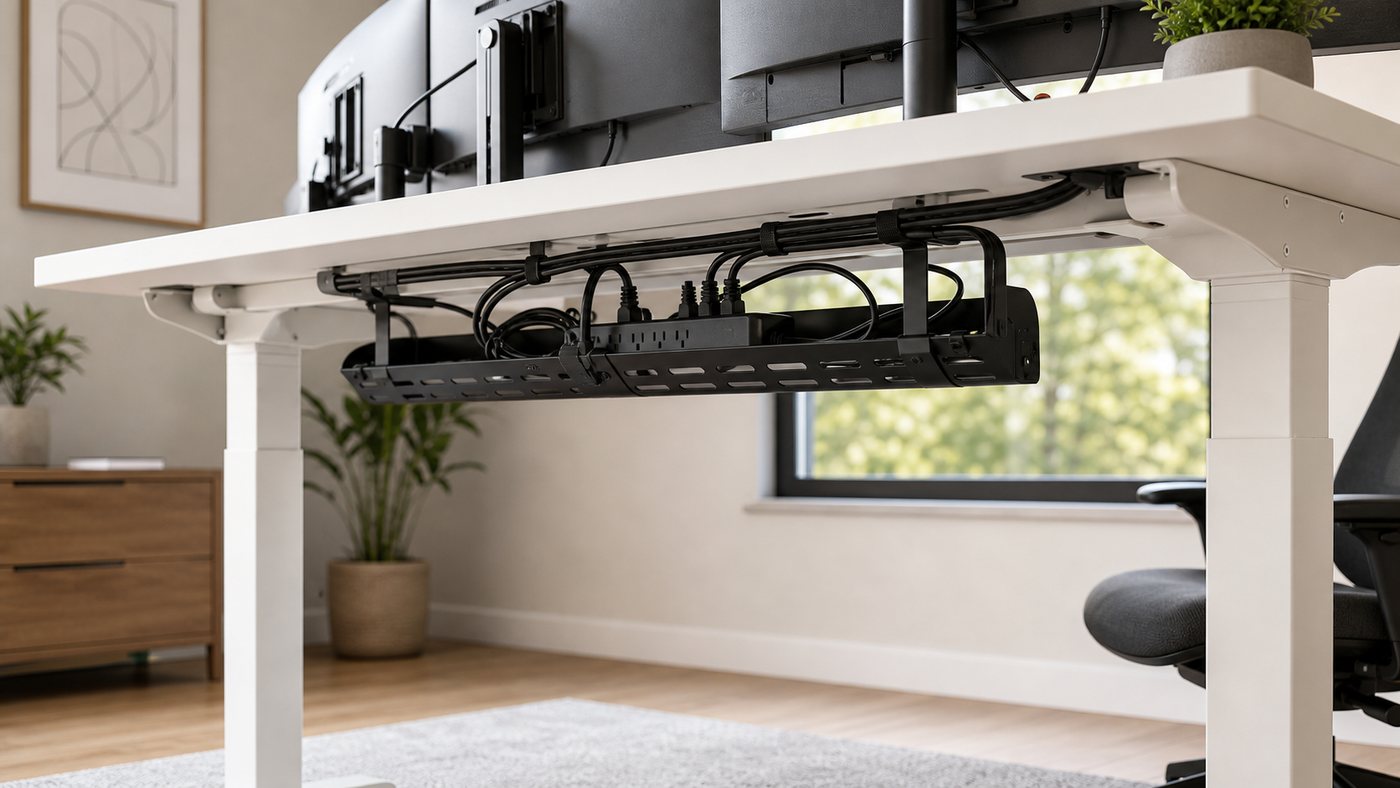
    6. Move cables behind the desk or under the tabletop to keep the setup clean.

    For a cleaner desk layout, see Cable Management Ideas for a Cleaner Desk Setup.

    FAQ

    What is the best desk lamp color for video calls?

    Neutral white is usually the safest choice for video calls because it looks natural and does not make your face too orange or too blue. A lamp with adjustable color temperature gives you the most flexibility.

    Should a desk lamp be behind the monitor?

    Usually no. A lamp behind the monitor can create uneven lighting or make your camera darken your face. Side lighting is usually better for video calls and eye comfort.

    Are LED desk lamps good for eyes?

    LED desk lamps can be comfortable when they have dimming, diffusion, and adjustable positioning. Avoid staring directly into bright LEDs and reduce brightness when working at night.

    Is warm or cool light better for home office work?

    Neutral light is best for most daytime work. Warm light is better for reading or late evening tasks. Cool light can help with detail-focused work, but it may feel tiring if it is too bright.

    Final Thoughts

    The best desk lamp for video calls and eye comfort should be adjustable, dimmable, and easy to position. Start with soft side lighting, avoid screen reflections, and choose a color temperature that fits the time of day. A simple lamp can make your workspace feel much more comfortable without adding clutter.

    For the broader home office setup, start with the pillar guide: Best Desk Organization Products for Small Home Offices. If you also read at night, you may like Best Rechargeable Book Light for Reading in Bed Without Waking Your Partner.

  • Best Health, Wellness, and Longevity Gadgets for 2026: A Practical Buyer Guide for Recovery, Sleep, and At-Home Self-Care

    Best Health, Wellness, and Longevity Gadgets for 2026: A Practical Buyer Guide for Recovery, Sleep, and At-Home Self-Care

    Affiliate disclosure: As an Amazon Associate, I earn from qualifying purchases. This post contains affiliate links. If you buy through them, I may earn a commission at no extra cost to you.
    Health note: Wellness devices and supplements are not substitutes for medical care. If you have a health condition, use prescriptions, are pregnant, or have unexplained symptoms, talk with a qualified clinician before using new therapy devices or supplements.

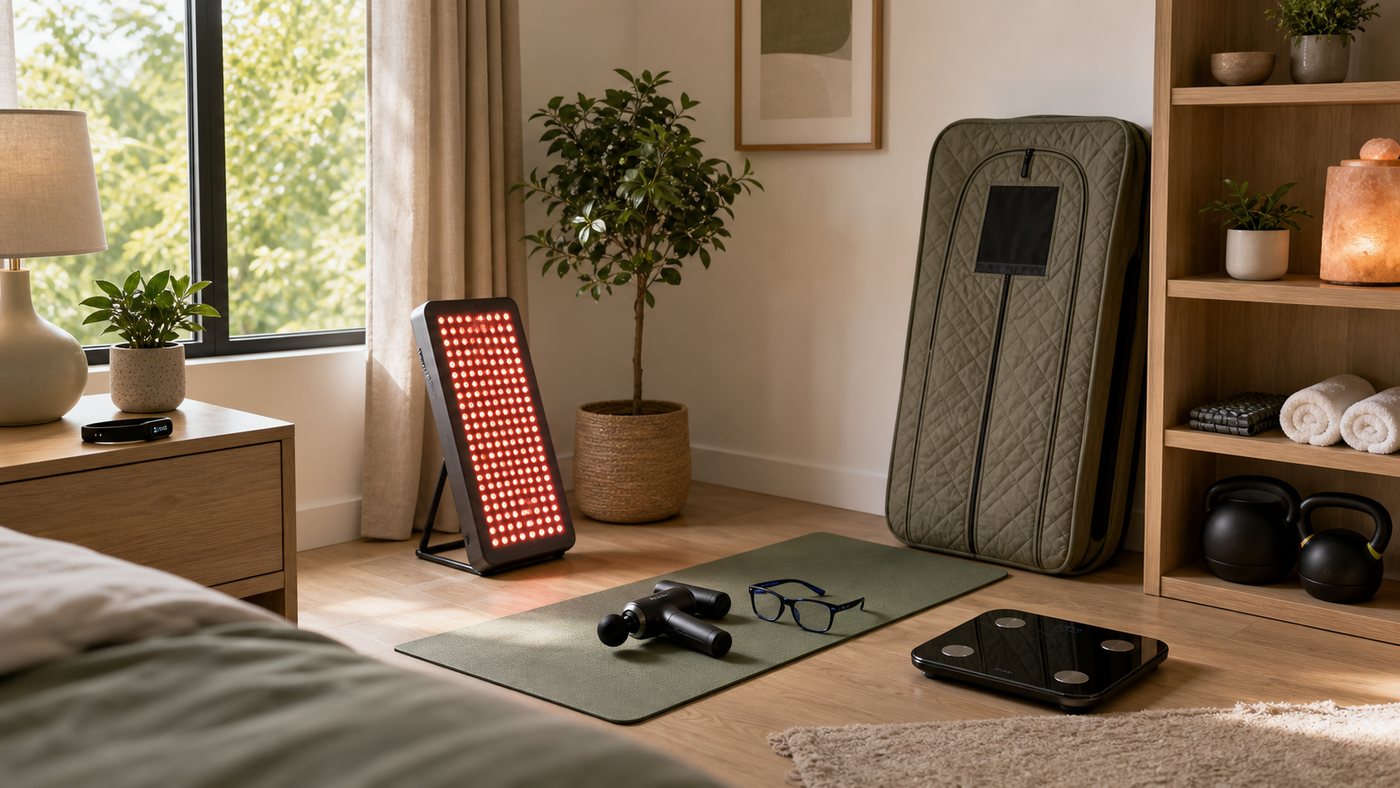
    Wellness room with sleep tracker red light panel smart scale cold plunge and recovery tools

    The 2026 wellness market is full of products that sound futuristic: wearable sleep trackers for athletes, red light therapy panels, portable cold plunge tubs, infrared sauna tents, glucose monitors, PEMF therapy mats, and smart scales that estimate visceral fat. Some are genuinely useful when chosen carefully. Others become expensive clutter because the buyer never matched the product to a specific habit, metric, or recovery problem. This guide is written for shoppers who want practical help, not hype.

    A good wellness purchase should answer one clear question. Do you want better sleep consistency? More recovery data after training? A relaxing heat routine in a small apartment? A way to make cold exposure easier outdoors? A scale that helps you track trends beyond body weight? When the goal is clear, features become easier to judge. Battery life, app fees, FDA clearance, wavelength ranges, safety warnings, sanitation, and return policies matter much more than dramatic marketing language.

    Quick Comparison: 2026 Wellness Keywords and What They Really Mean

    Keyword Good fit Buyer checks Amazon
    best wearable sleep tracker for athletes Recovery-focused training HRV trends, comfort, battery life, subscription cost Check Options on Amazon
    red light therapy panel for home use Consistent at-home light routine FDA-cleared status, eye protection, wavelength, coverage area Check Options on Amazon
    portable cold plunge tub for outdoor use Patio or backyard recovery Insulation, drainage, sanitation, cover, setup footprint Check Options on Amazon
    portable infrared sauna tent for apartment Small-space heat sessions Power draw, ventilation, chair fit, timer, safety shutoff Check Options on Amazon
    continuous glucose monitor without subscription Glucose trend tracking Eligibility, sensor cost, app support, clinician guidance Check Options on Amazon
    massage gun for plantar fasciitis relief Foot and calf relaxation Low speed control, soft attachments, stall force, noise Check Options on Amazon
    blue light blocking glasses for gaming over prescription Glasses wearers who game late Fit over frames, lens tint, comfort, screen color distortion Check Options on Amazon
    best nad+ supplement for anti aging Supplement shoppers Third-party testing, dosage transparency, medication interactions Check Options on Amazon
    smart scale with visceral fat measurement Trend tracking at home App privacy, repeatability, multi-user mode, trend reports Check Options on Amazon
    pemf therapy mat for back pain Relaxation routines Contraindications, intensity levels, timer, return policy Check Options on Amazon

    1. Sleep Trackers for Athletes: Look Beyond Sleep Stages

    Sleep stage charts are interesting, but athletes usually get more value from trends: resting heart rate, heart-rate variability, sleep timing, temperature changes, and how recovery scores respond to hard sessions. In 2026, the best wearable sleep tracker for athletes may be a ring, watch, band, or even a strap-based system depending on comfort and sport. A runner who hates sleeping with a watch may prefer a ring. A strength athlete who already wears a fitness watch may want one device for training and sleep. A team-sport athlete might care most about battery life and durability.

    Before buying, check whether the core features require a subscription. Also remember that consumer wearables are guidance tools, not diagnostic devices. Use them to spot patterns, not to panic over one bad night. If the device helps you go to bed at a consistent time, reduce late caffeine, or adjust training after several rough nights, it is doing its job.

    Athlete checking sleep recovery data on a wearable device after morning training
    For athletes, sleep tracking is most useful when it changes behavior, not when it becomes another scoreboard.

    2. Red Light Panels, Infrared Sauna Tents, and Cold Plunge Tubs

    Red light therapy panels for home use have become popular because they are simple: stand or sit near the panel, follow the timer, and repeat consistently. The American Academy of Dermatology notes that many red-light devices are marketed as FDA-cleared, which indicates a low-risk device category, but at-home products are not the same as professional treatments. Look for clear safety instructions, eye protection guidance, wavelength information, and a realistic coverage area. Bigger is not always better if you cannot fit it into your routine.

    A portable infrared sauna tent for an apartment should be judged by practical details: how much heat it produces, whether the chair is comfortable, how easily it folds, whether the timer and shutoff feel reliable, and where moisture goes after use. For cold plunges, the basic questions are even more physical. Can you drain it without flooding the patio? Can you keep water clean? Is the cover secure? Can you step in and out safely? Cold exposure is intense, so start gently and avoid it if you have conditions that make it risky unless a clinician says it is appropriate.

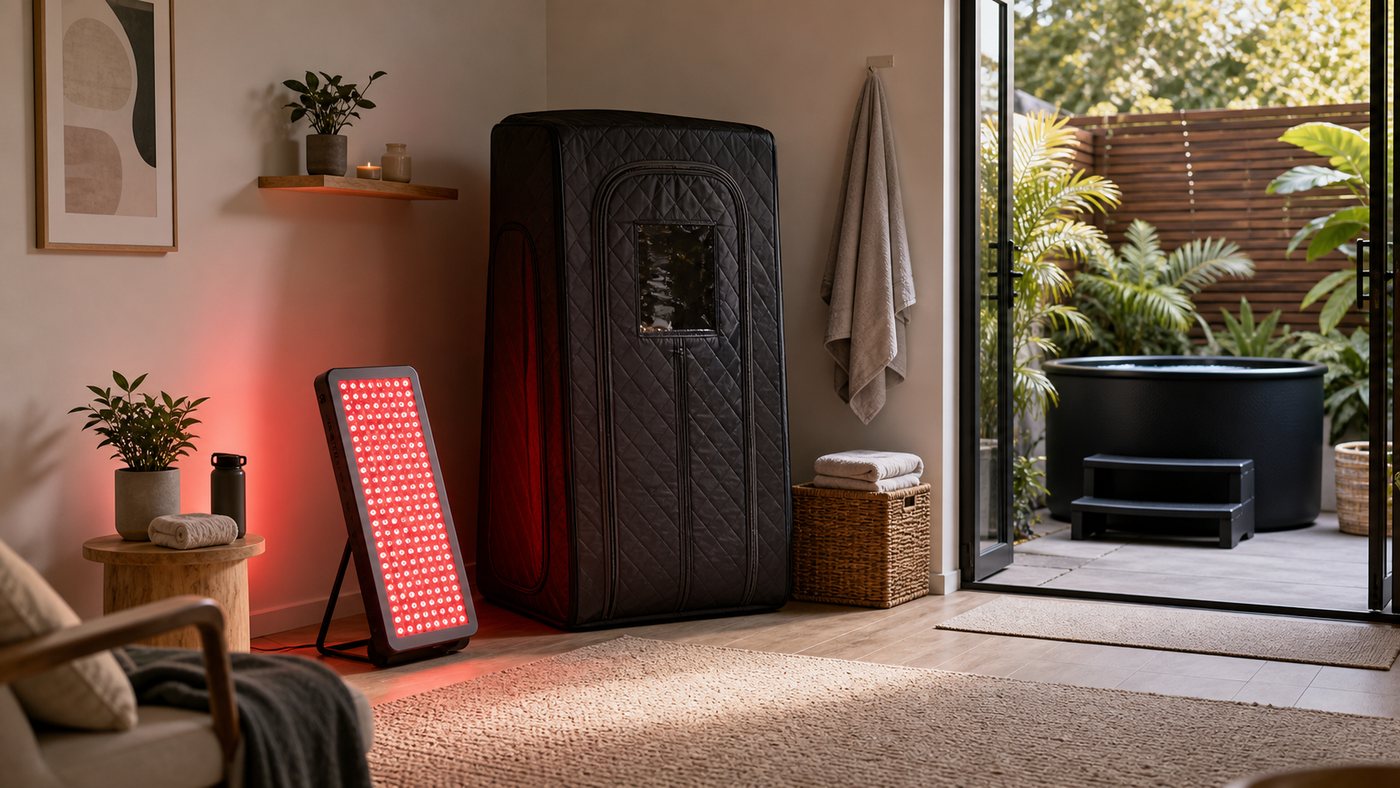
    Home recovery area with red light therapy panel infrared sauna tent and outdoor cold plunge tub
    Recovery gear works best when the setup is simple enough to use several times per week.

    3. Glucose Monitors, Smart Scales, and Supplements

    Continuous glucose monitors without subscription fees are attractive, but availability and rules can vary by product, country, and user type. Some systems are designed for people with diabetes; others are marketed for metabolic awareness. If you are using a CGM for health decisions, involve a professional. If you are using it for general curiosity, focus on trend learning rather than one-off spikes. Food, sleep, stress, illness, and exercise can all affect readings.

    Smart scales with visceral fat measurement use bioelectrical impedance estimates, so do not treat the number as a perfect medical measurement. The value is consistency. Weigh at the same time, under similar conditions, and watch the trend line over months. For NAD+ supplements, be extra careful with claims. Choose brands with transparent ingredients, third-party testing when available, and clear serving information. Supplements can interact with medications or conditions, and anti-aging claims are often broader than the evidence.

    4. Massage Guns, Blue Light Glasses, and PEMF Mats

    A massage gun for plantar fasciitis relief should have a gentle low-speed setting and soft attachment options. Many people do better using it around the calves and surrounding tissues rather than aggressively pounding the painful heel. Stop if pain increases. Blue light blocking glasses for gaming over prescription glasses should be comfortable enough to wear for a full session and should not distort colors so heavily that games look unpleasant. For sleep, reducing late-night brightness and taking breaks may matter as much as the glasses.

    PEMF therapy mats for back pain sit in a category where shoppers need to read contraindications carefully. If you have implanted medical devices, are pregnant, or have a complex health history, do not casually experiment. For general relaxation, look for adjustable intensity, a timer, a comfortable mat surface, and a seller with a clear return policy. The more medical the marketing sounds, the more skeptical you should be.

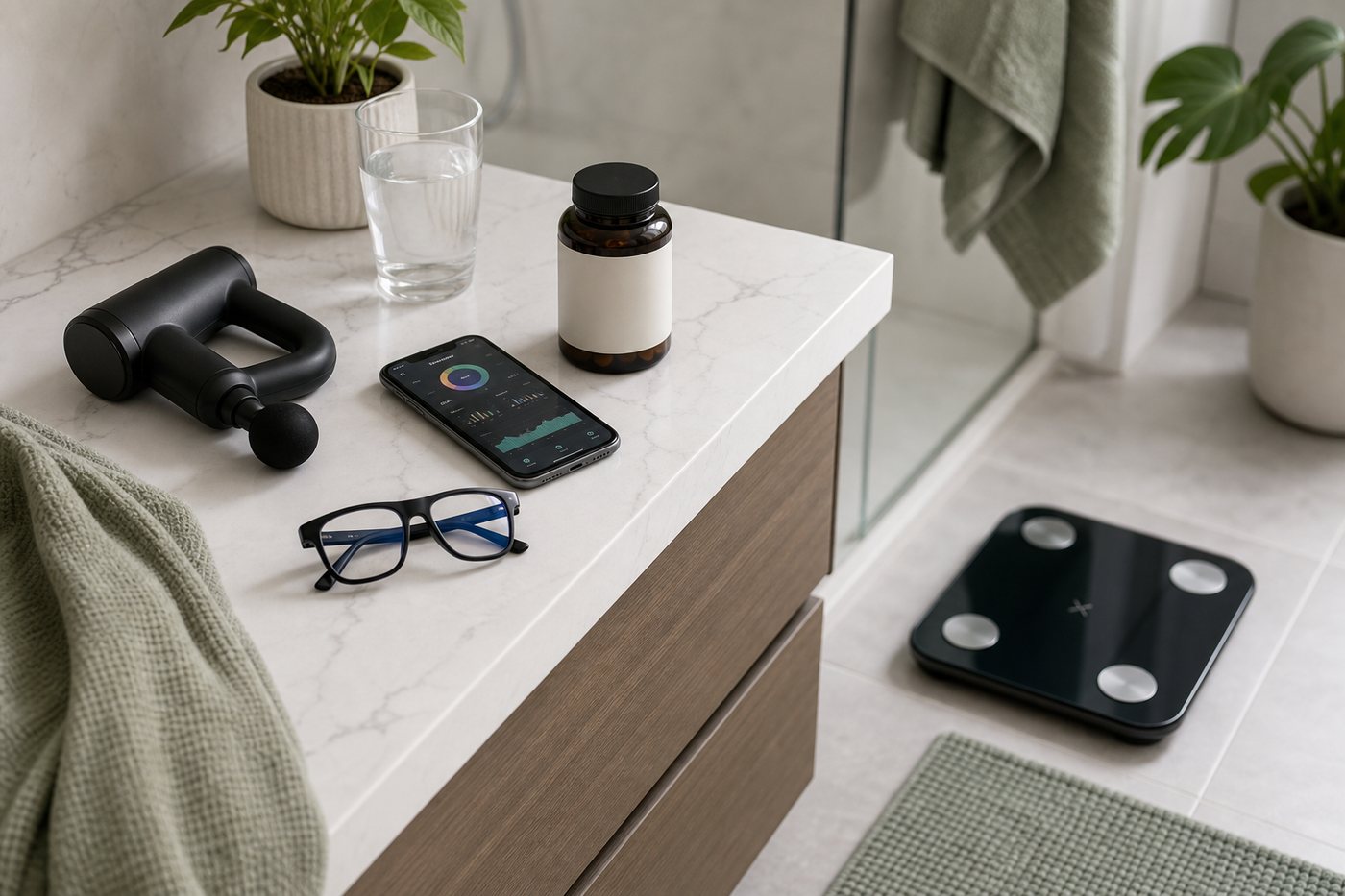
    Smart scale massage gun blue light glasses and wellness tracking app on a clean bathroom counter
    Small wellness tools can be useful when they support repeatable routines and honest trend tracking.

    Final Buying Advice

    For 2026 wellness products, the best purchase is usually the one that makes a healthy routine easier to repeat. A sleep tracker should make sleep habits clearer. A red light panel should be easy to use safely. A cold plunge should be easy to drain and clean. A smart scale should show trends without turning every morning into a judgment. A supplement should have transparent labeling and modest claims. Buy the tool that fits your life, not the tool that promises to reinvent it overnight.

    Sources and Further Reading

  • Best Monitor Stands with Storage for Small Desks: A Cleaner Home Office Setup

    Best Monitor Stands with Storage for Small Desks: A Cleaner Home Office Setup

    Affiliate disclosure: As an Amazon Associate I earn from qualifying purchases. This guide uses affiliate links to Amazon.com.

    A small desk can feel crowded even when you only use a monitor, keyboard, mouse, notebook, and a few chargers. The problem is usually not the size of the room. It is the lack of vertical space. A good monitor stand with storage gives your screen a better height, creates a parking spot for your keyboard, and turns the dead space under the monitor into useful storage.

    This guide focuses on practical monitor stands for small desks, not oversized decorative risers. If you are building a cleaner home office setup from scratch, start with our main guide to best desk organization products for small home offices, then use this article to choose the right monitor stand.

    Browse monitor stands with storage for small desks on Amazon

    Quick picks by desk problem

    • Small desk with no drawers: choose a monitor stand with open shelf storage.
    • Paper clutter: choose a stand with a drawer or side compartments.
    • Keyboard always in the way: choose a stand with enough clearance underneath.
    • Neck strain: choose a stand that raises the screen closer to eye level.
    • Many chargers and accessories: choose a wider stand with cable space behind it.

    Why a monitor stand works so well on a small desk

    A monitor stand is one of the rare desk upgrades that improves both organization and ergonomics. It lifts the monitor, frees space underneath, and gives small accessories a predictable home. That matters because a small desk becomes messy when every item competes for the same flat surface.

    The best monitor stands with storage solve three common problems. First, they reduce visual clutter by giving your keyboard, notebook, and small tools a place to go. Second, they improve posture by raising the monitor. Third, they make daily cleanup faster because you can reset the desk without moving everything to another room.

    If cables are also part of the problem, pair the stand with a simple system from our cable management ideas for a cleaner desk setup guide.

    What to look for before buying

    1. Enough height, but not too much

    The goal is to bring the top third of your screen closer to eye level. A stand that is too low will not help posture. A stand that is too high can make you tilt your head back. For many desks, a monitor rise of about 3 to 5 inches is a practical range, but the right height depends on your chair, desk, monitor size, and body position.

    2. Usable storage underneath

    Do not buy a stand only because it says “storage.” Look at the usable opening. Can your keyboard slide under it? Can a notebook fit? Is there enough width for a small tray or hub? Open shelf storage is usually better for people who reset their desk daily, while drawers are better for hiding small tools.

    3. Width that matches the desk

    On a small desk, the stand should not dominate the entire surface. A compact stand works well for a single monitor. A wider stand may be useful if you want to store a keyboard, trackpad, small notebook, and USB-C hub underneath. Measure your desk before buying, especially if your speakers, lamp, or laptop stand also need space.

    4. Stable material

    Wood, metal, and sturdy composite materials can all work. The key is stability. A stand should not flex when you type, bump the desk, or adjust the monitor. If you use a heavy monitor, check the weight capacity and avoid flimsy plastic risers.

    5. Cable space behind the stand

    A monitor stand can make cables look cleaner, but only if there is room behind it for routing. If the stand sits flush against the wall, cables may bend awkwardly. A little rear clearance helps you route display, power, keyboard, and charging cables without creating a new tangle.

    Best types of monitor stands with storage

    Open shelf monitor stands

    This is the simplest and most flexible option. It gives you space under the monitor for a keyboard, notebook, dock, or small tray. Open shelf stands are ideal for small home offices because they keep everyday items visible and easy to reset.

    Check open shelf monitor stands on Amazon

    Monitor stands with drawers

    A drawer is useful if your desk collects pens, sticky notes, adapters, receipts, or memory cards. The tradeoff is that drawers can become clutter zones if you never empty them. Choose this style if you want to hide small items but still access them daily.

    Browse monitor stands with drawers on Amazon

    Metal mesh monitor stands

    Metal mesh stands are usually lightweight, affordable, and visually simple. They often work well in basic office setups. The downside is that some models have less warm style than wood and may not offer much storage beyond the open space underneath.

    Wide monitor risers for dual-use desks

    If your desk is both a work desk and a writing table, a wide monitor riser can create a clean zone under the screen. You can tuck the keyboard away when writing, planning, or doing paperwork. This is especially useful in apartments where one desk has to serve several jobs.

    How to set up a monitor stand cleanly

    After choosing a stand, place only the items you use daily underneath it. A keyboard, notebook, small tray, or USB-C hub makes sense. Random spare cables, old receipts, and tools you rarely use should live somewhere else. The stand should make your desk easier to reset, not become a hidden junk shelf.

    Route the monitor cable and power cable behind the stand. If the cables drop below the desk, use clips or an under-desk tray. Our guide to an under desk cable management tray for small home offices explains how to hide the power strip and extra cable length below the desktop.

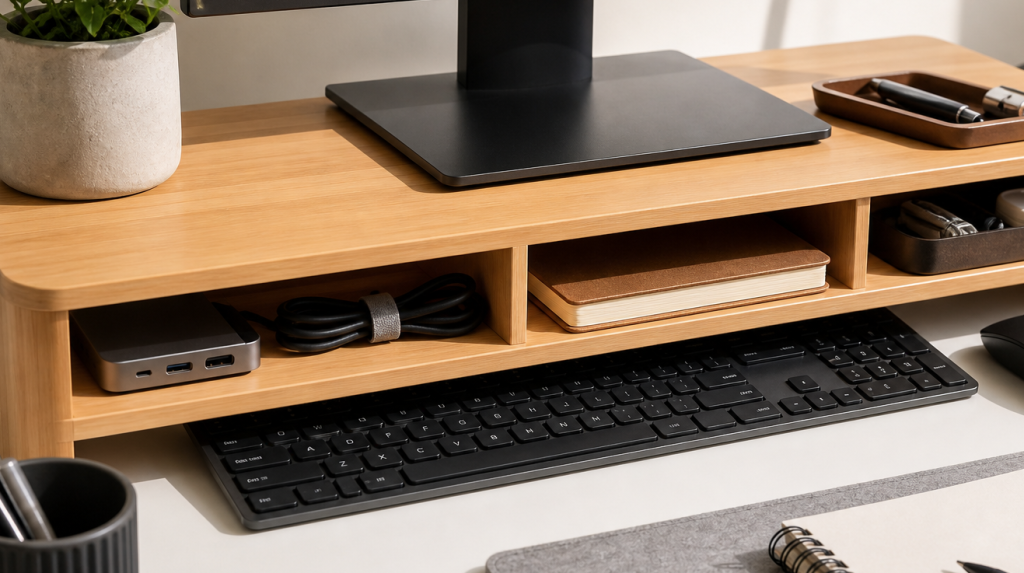
    Small home office desk with monitor stand and simple cable organization

    Monitor stand vs monitor arm

    A monitor arm is better if you want maximum flexibility and a floating screen. It can free more desk surface than a stand. However, it needs a strong desk edge, proper clamp clearance, and more installation time. A monitor stand is easier, cheaper, and more renter-friendly.

    For most small home offices, a monitor stand is the safer first upgrade. It gives you storage immediately and does not require tools. If you later upgrade to a monitor arm, you can still use the stand as a shelf, laptop platform, or printer riser.

    Who should buy a monitor stand with storage?

    • People with small desks and no built-in drawers.
    • Remote workers who want a cleaner desk between meetings.
    • Students who need space for a keyboard and notebook.
    • Apartment dwellers who want a no-drill desk upgrade.
    • Anyone improving posture before buying a new chair.

    What not to buy

    Avoid stands that are too narrow for your keyboard, too tall for your seating position, or too flimsy for your monitor. Also be careful with stands that have many tiny compartments. They look useful at first, but too many compartments can encourage more clutter instead of better organization.

    FAQ

    Is a monitor stand worth it for a small desk?

    Yes, if your monitor sits too low or your keyboard and accessories are always in the way. A monitor stand adds vertical storage without taking much extra floor or desk space.

    How tall should a monitor stand be?

    The right height depends on your chair, desk, monitor, and posture. In general, the screen should feel comfortable without forcing you to look down or tilt your head back.

    Is wood or metal better for a monitor stand?

    Both can work. Wood often looks warmer and fits home offices well. Metal is usually slimmer and may feel more utilitarian. Stability matters more than material.

    Can I use a monitor stand with a laptop?

    Yes, but a dedicated laptop stand is usually better for lifting a laptop screen. A monitor stand works well when the laptop is closed, docked, or used beside an external monitor.

    Should I buy a monitor stand or a cable tray first?

    If your main problem is desktop clutter, start with a monitor stand. If the biggest mess is under the desk, start with a cable tray or read our guide to the best cable management box for messy desk cords.

    Final recommendation

    For most small desks, the best monitor stand with storage is a stable open-shelf riser that is wide enough for your keyboard and low enough to keep the monitor comfortable. Add a drawer only if you have small items you truly use every day. Keep the setup simple, route cables behind the stand, and connect it with a broader desk organization system.

    Related home office guides

  • Top 10 Home Office and Smart Home Upgrades for 2026: Practical Picks for Comfort, Focus, and Everyday Control

    Top 10 Home Office and Smart Home Upgrades for 2026: Practical Picks for Comfort, Focus, and Everyday Control

    Affiliate disclosure: As an Amazon Associate, I earn from qualifying purchases. This article contains affiliate links, which means I may earn a commission if you buy through these links at no extra cost to you.

    Modern ergonomic home office with smart home devices and organized remote work setup

    The best home office upgrades in 2026 are not just about making your desk look nicer on video calls. They are about removing small daily annoyances: a desk that is too low for a tall person, a chair that leaves your lower back tired, cables that fight every standing-desk movement, a microphone that picks up every keyboard click, or a thermostat that treats the upstairs bedroom and downstairs office like the same climate. If you work from home, stream, manage a hybrid office, or simply want your house to feel more responsive, this guide covers the products worth comparing before you buy.

    Instead of chasing flashy features, the smart move is to match each upgrade to a real pain point. OSHA’s computer workstation guidance emphasizes that there is no single perfect posture for everyone, but there are design goals that reduce awkward positions and make long computer work more comfortable. In plain English: buy adjustable gear, set it up carefully, and change positions often. That same practical mindset applies to smart home devices too. The right product is the one that fits your room, wiring, Wi-Fi situation, Apple HomeKit or Matter ecosystem, and daily routine.

    Quick navigation:
    Comparison table |
    Buying guide |
    Setup tips |
    FAQ

    Quick Comparison: What to Shop For First

    Keyword Best for What to check in 2026 Amazon
    best ergonomic standing desk for tall people Tall remote workers Maximum height, stability at full extension, programmable presets Check Options on Amazon
    under desk treadmill for heavy adults Low-speed walking during work Weight capacity, motor noise, deck width, return policy Check Options on Amazon
    noise cancelling microphone for open office Calls in shared spaces Directional pickup, software noise reduction, mute controls Check Options on Amazon
    smart blinds compatible with apple homekit Apple smart homes HomeKit/Matter support, motor noise, window size, power type Check Options on Amazon
    posture correcting desk chair for lower back pain Long sitting sessions Lumbar support, seat depth, armrest adjustment, trial period Check Options on Amazon
    dual monitor mount for curved screens Large desk setups VESA size, monitor weight, arm reach, curve clearance Check Options on Amazon
    battery powered outdoor security camera no wifi Remote gates, sheds, cabins Cellular plan, local storage, weather rating, battery swaps Check Options on Amazon
    adjustable laptop stand for bed reading Bedside reading and light work Stability, heat ventilation, angle range, wrist comfort Check Options on Amazon
    under desk cable management tray for standing desk Clean sit-stand setups Tray depth, clamp vs screw mount, power strip fit Check Options on Amazon
    smart thermostat for multiple zones without c wire Older multi-zone homes C-wire adapter, zone compatibility, HVAC type, app controls Check Options on Amazon

    How to Choose the Right Upgrade

    1. Start with ergonomics, not aesthetics

    A tall person shopping for an ergonomic standing desk should ignore most product photos and go straight to the height range. Many desks look premium but do not rise high enough for someone over six feet tall to keep elbows near a comfortable angle. Look for a frame that remains stable near its maximum height, a wide surface that fits your keyboard and monitor depth, and preset controls so you can switch between sitting and standing without guessing. If you add an under-desk treadmill, make sure the desk can still reach your typing height while you stand on the treadmill deck.

    Tall user friendly standing desk with monitor arms ergonomic chair and under desk treadmill
    A strong 2026 workstation starts with adjustability: desk height, chair fit, monitor placement, and walking room.

    2. Treat movement as a gentle habit

    An under-desk treadmill for heavy adults should be selected more like office equipment than gym equipment. The important details are weight capacity, low-speed smoothness, motor sound, deck width, and how easy it is to move when you need normal desk space. A treadmill that is too narrow or loud will become a storage problem. For most work sessions, the goal is slow walking while reading, taking calls, or sorting tasks, not sprinting through your inbox.

    3. Buy audio before buying another webcam

    Open offices and busy homes make microphones work hard. A noise cancelling microphone for open office use should have a directional pickup pattern, a physical mute button, stable USB or wireless connection, and software that handles fan noise, keyboard taps, and distant voices without making your voice sound robotic. For shared desks, a compact desktop mic or headset-style mic may outperform a beautiful microphone that sits too far away from your mouth.

    4. Check ecosystem compatibility before smart home purchases

    Smart blinds compatible with Apple HomeKit are excellent for glare control, privacy, and energy routines, but compatibility details matter. Some products support HomeKit directly; others need a hub; newer devices may support Matter, which can make cross-platform control easier. Also decide whether you want battery-powered motors, hardwired shades, or retrofit kits for existing blinds. For bedrooms, motor noise and schedule reliability are just as important as app features.

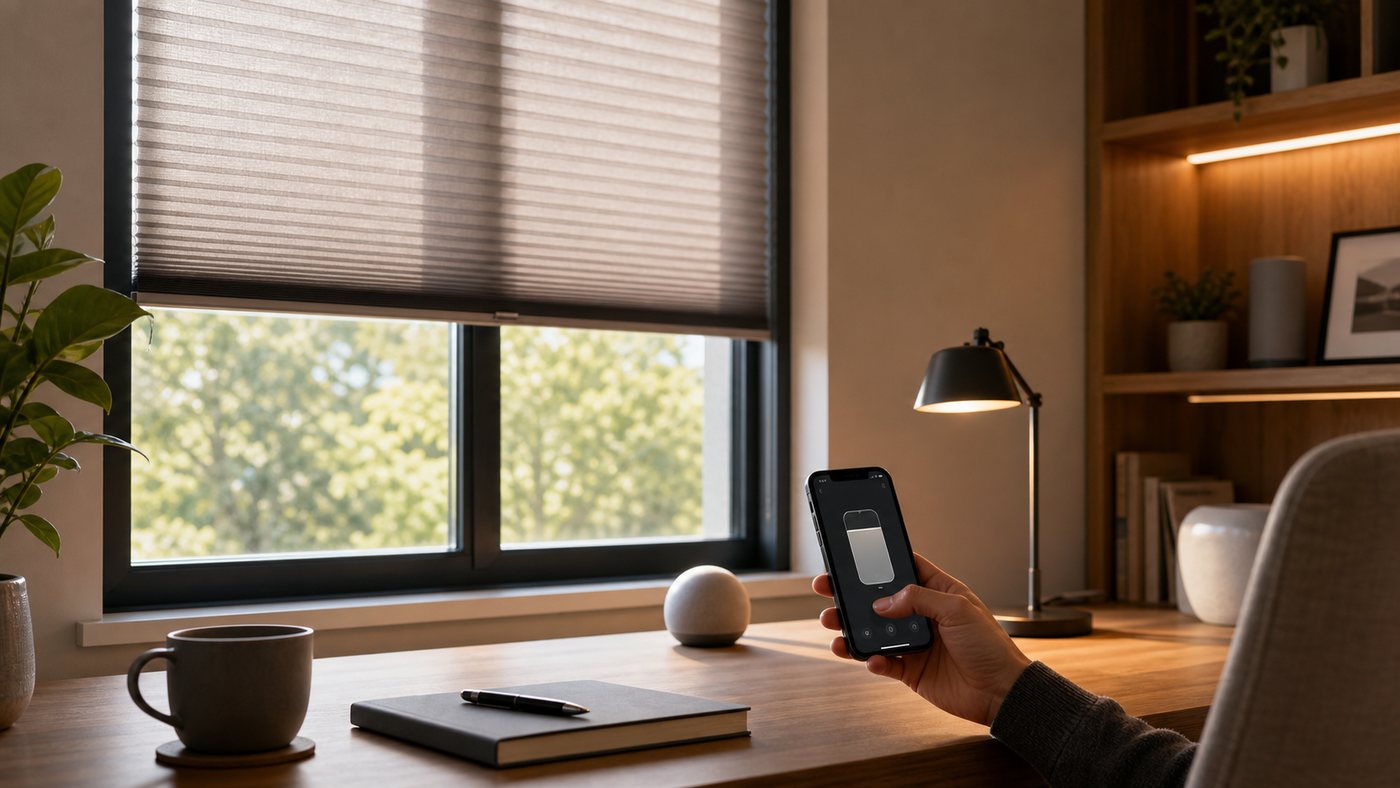
    Home office window with automated smart blinds and soft daylight controlled by phone
    Smart blinds are most useful when they solve glare and privacy automatically instead of adding another app chore.

    5. Lower-back comfort is about fit

    A posture correcting desk chair for lower back pain should not force you into one rigid pose. Better chairs support movement while keeping your spine, hips, and shoulders in a comfortable working range. Look for adjustable lumbar support, seat depth control, armrests that do not push your shoulders upward, and a return policy. If you have persistent pain, treat the chair as a comfort tool, not medical treatment, and consider professional advice.

    6. Plan monitor mounts and cable trays together

    Dual monitor mounts for curved screens need extra attention because curved displays can be wider, heavier, and deeper than standard monitors. Confirm the VESA pattern and weight limit for each arm. Then add an under desk cable management tray for your standing desk so power bricks and cables move as one organized system. Leave enough slack for the desk at full height, secure the power strip, and avoid routing cables where they can pinch against the frame.

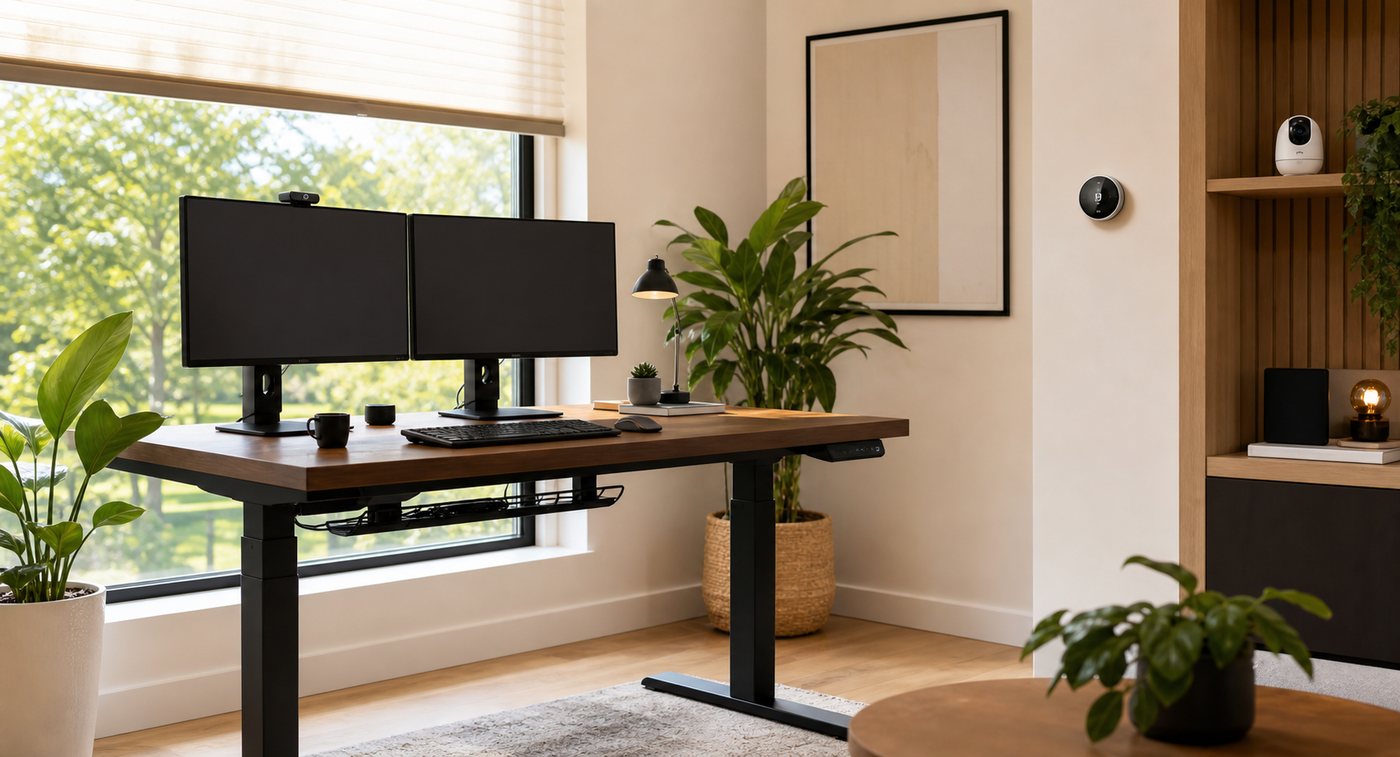
    Neat under desk cable management tray on a standing desk with dual curved monitors
    Cable management is not cosmetic on a sit-stand desk. It protects plugs, adapters, and your patience.

    7. Be realistic about no-Wi-Fi cameras and no-C-wire thermostats

    A battery powered outdoor security camera with no Wi-Fi usually means cellular connectivity or local recording. That can be ideal for a farm gate, storage shed, boat dock, or temporary construction site, but check monthly data costs, signal strength, weather rating, and battery replacement routines. Likewise, a smart thermostat for multiple zones without a C wire is possible in many homes, but HVAC wiring varies. Before buying, compare your current thermostat wiring with the manufacturer’s compatibility checker and confirm whether a power adapter is included.

    A Simple 2026 Setup Order

    If you are upgrading slowly, start with the pieces that affect your body and communication every day: chair, desk, monitor height, microphone, lighting, and cable tray. Then add convenience devices such as smart blinds, cameras, and thermostats. This order usually gives the biggest quality-of-life improvement first. It also prevents a common mistake: buying smart gadgets while the basic desk still causes neck strain or messy cable failures.

    For small rooms, prioritize compact gear with multiple roles. A strong monitor arm frees desk space. A cable tray hides power bricks. Smart blinds reduce glare without adding curtains. A slim noise-cancelling microphone improves calls without filling the desk. For larger rooms, think in zones: work zone, storage zone, lighting zone, and comfort zone. The products above become easier to choose when you know which zone they improve.

    FAQ

    Are standing desks worth it in 2026?

    Yes, if you use them to change position throughout the day. A standing desk is not magic by itself. The value comes from adjustability, better monitor placement, and the option to sit, stand, and walk gently.

    Should I buy exact product recommendations or search by features?

    Search by features first. Product availability, bundles, and specs change quickly, especially on Amazon. Use the affiliate links above as starting points, then verify current details on the product page before purchasing.

    What is the safest affiliate approach for Amazon posts?

    Use a clear disclosure, mark paid links, avoid copying Amazon reviews or star ratings, and do not publish fixed prices unless they come from an approved real-time method. This article uses feature-based guidance and search links to keep the content useful and easier to maintain.

    Final Take

    The smartest home office setup in 2026 is calm, adjustable, and boring in the best way. It lets your body move, keeps your voice clear, handles cables cleanly, and automates the home features that used to interrupt your day. Start with the pain point you feel most often, compare products by fit and compatibility, and build a workspace that feels good after the first hour and the fifth.

    Sources and Further Reading

    Related home office guides

  • The 2026 Guide to Electronics, Tech Accessories, and Content Creator Tools: Build Smarter, Create Better

    The 2026 Guide to Electronics, Tech Accessories, and Content Creator Tools: Build Smarter, Create Better


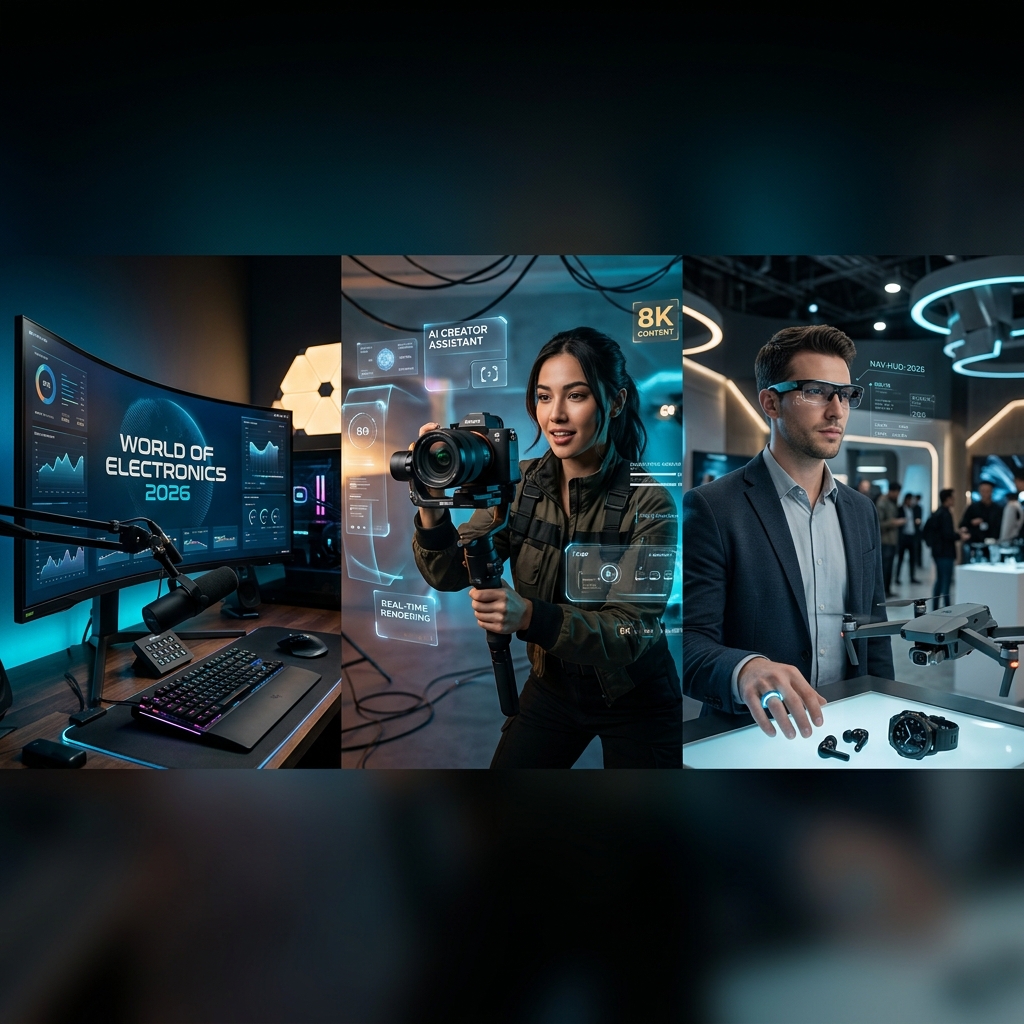
    Cinematic panoramic overview of the 2026 world of electronics, tech accessories, and content creation tools — premium desk setup, dynamic content creator with AI holographic elements, wearable tech, and foldable drone

    There is a moment — and every tech enthusiast knows it — when you unbox a new device that genuinely changes how you work, create, or experience digital life. Not a marginal upgrade. Not a slightly faster version of the same thing. A genuine paradigm shift. In 2026, those moments are happening with extraordinary frequency.

    The electronics and tech accessories landscape has evolved beyond the era of specifications wars and benchmarks bragging rights. The defining characteristic of 2026 hardware is intelligence — not just raw processing power, but the ability to adapt, anticipate, and integrate seamlessly into your workflow without demanding your constant attention. For content creators specifically, this means the tools are finally getting out of the way and letting you focus on what actually matters: telling compelling stories, connecting authentically with an audience, and producing work you are genuinely proud of.

    This guide covers the most significant trends, innovations, and practical buying advice across three interconnected worlds: everyday tech accessories, professional-grade creator tools, and the AI-powered software layer that ties everything together. Whether you are a seasoned YouTuber upgrading your production pipeline, a podcaster setting up your first serious studio, or a tech-forward professional building the ultimate portable workflow, this is where the industry stands right now.


    1. The Invisible Tech Revolution: Accessories That Disappear Into Your Life
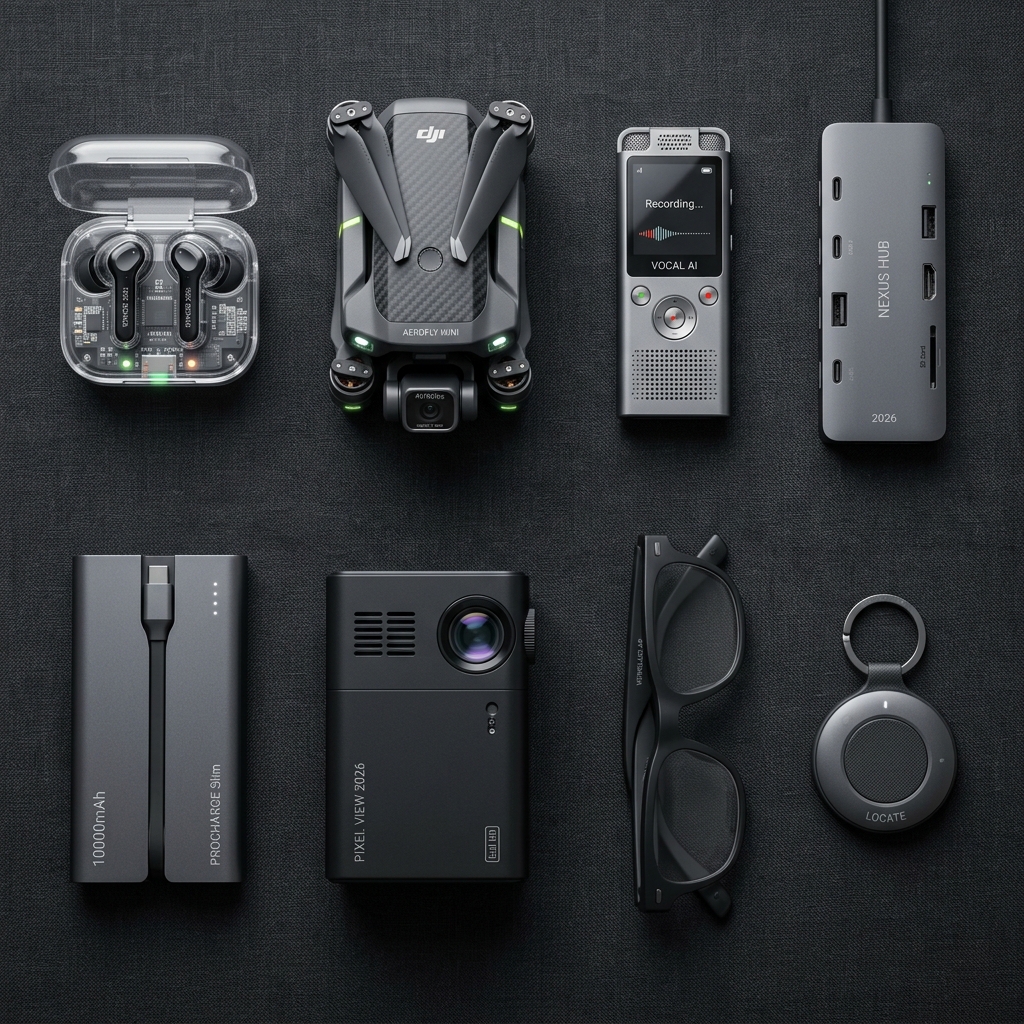
    Beautiful flat-lay of portable 2026 tech accessories on dark charcoal linen — transparent wireless earbuds, foldable drone, AI voice recorder, USB-C hub, slim power bank, mini projector, smart AR glasses, and Bluetooth tracker


    The most important trend in consumer tech accessories for 2026 can be summarized in a single word: ambient. The best accessories are the ones you stop thinking about because they work so intuitively that they blend into the background of your daily life. This is a philosophical shift from the “look at my gadget” era to the “it just works” era.

    Smart Rings: The Silent Powerhouse

    If 2024 was the year smart rings entered the mainstream conversation, 2026 is the year they proved their value. The latest generation of smart rings has moved well beyond basic step counting. Modern smart rings now offer:

    • Continuous Health Monitoring: Heart rate variability (HRV), blood oxygen saturation, skin temperature trends, and stress-level estimation — all without wearing a bulky watch to bed.
    • Gesture Control: Subtle finger movements can dismiss phone calls, control music playback, or trigger smart home scenes. The ring becomes a discreet remote control for your digital life.
    • NFC Payments and Access: Tap your ring on a payment terminal or a smart lock. No phone needed, no watch needed. Just your hand.
    • Subscription-Free Models: A notable trend in 2026 is the rise of smart rings that offer full functionality without mandatory monthly subscriptions — a direct response to consumer backlash against recurring fees for hardware they have already purchased.

    Smart Glasses: From Novelty to Daily Driver

    Smart glasses have crossed the usability threshold in 2026. The current generation is lightweight enough to wear all day (under 40 grams for some models), aesthetically indistinguishable from regular eyewear, and functionally compelling. Key capabilities include:

    • Real-Time Translation: See translated text overlaid on your field of vision during face-to-face conversations in a foreign language. This single feature has made smart glasses indispensable for international travelers and business professionals.
    • AR Navigation: Subtle directional arrows appear at the edge of your vision while walking or cycling, keeping your eyes on the road rather than glued to a phone screen.
    • Notification Triage: Incoming messages, calendar alerts, and delivery notifications appear briefly at the periphery of your vision. Urgent items are highlighted; everything else is silently logged for later.
    • Integrated Audio: Open-ear speakers built into the temple arms deliver clear personal audio for calls and music without blocking ambient sound — critical for safety and social awareness.

    The USB-C Ecosystem Has Finally Matured

    After years of confusion around USB-C standards, 2026 has brought welcome clarity. The universal adoption of USB4 Version 2.0 means a single USB-C cable can now deliver up to 80 Gbps of data transfer, 240W of power delivery, and dual 4K display output simultaneously. The practical impact is enormous: a single compact hub can connect your laptop to an external monitor, charge it, drive an external SSD, and connect a microphone — all through one port. The era of carrying five different cables and adapters is genuinely over.


    2. The Content Creator’s Studio: 2026 Edition

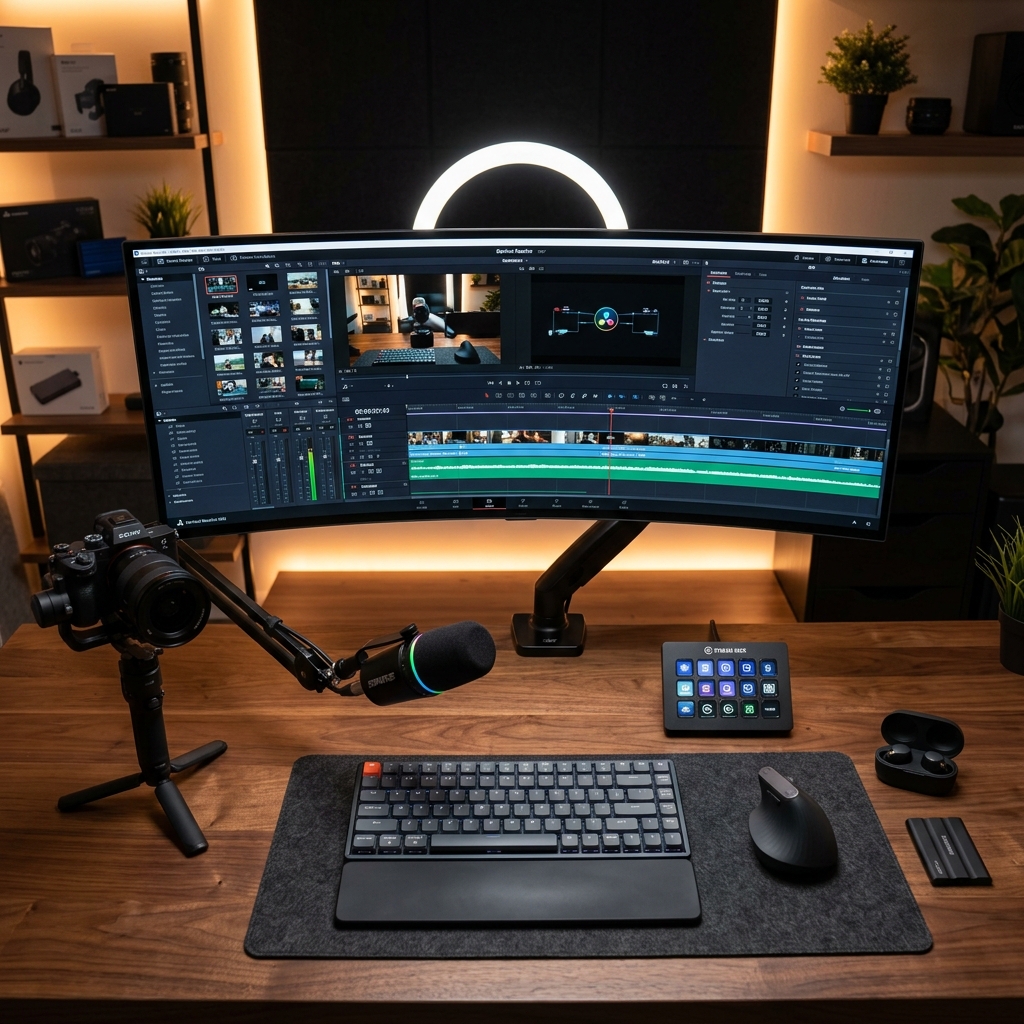
    Premium 2026 content creator desk setup — walnut desk with ultrawide curved OLED monitor showing video editing timeline, mirrorless camera on gimbal, USB-C condenser microphone, mechanical keyboard, stream deck, and wireless earbuds


    Building a creator studio in 2026 is simultaneously easier and more complex than ever. Easier because the quality floor has risen dramatically — even budget gear produces surprisingly good results. More complex because the sheer number of options can paralyze decision-making. Here is a structured breakdown of every major category, designed to help you invest wisely.

    Cameras: Matching the Tool to the Job

    The camera market in 2026 has stratified clearly into three practical tiers for creators:

    Use Case Best Camera Type What to Look For
    Streaming / Video Calls AI-Powered Webcams (e.g., Insta360 Link 2C Pro, Obsbot Tiny 2 Lite) Auto-framing, face tracking, gesture controls, 4K @ 30fps, built-in AI noise reduction
    Vlogging / YouTube Compact Mirrorless (e.g., Sony ZV-E10 II, Canon EOS R50) Flip-out screen, reliable autofocus with eye tracking, clean HDMI output, mic input, lightweight body
    Cinematic / Short Film Full-Frame Mirrorless (e.g., Sony A7 IV, Canon R6 III) 10-bit 4:2:2 internal recording, S-Log/C-Log profiles, in-body stabilization, dual card slots
    Action / Travel 360 Cameras (e.g., Insta360 X5) “Shoot first, frame later” workflow, invisible selfie stick, AI-powered reframing in post

    A critical 2026 insight: The rise of 360-degree cameras represents a fundamental shift in creator workflow. Rather than carefully composing every shot in real-time, you capture the entire scene and let AI-powered reframing software select the best angles, movements, and compositions in post-production. For solo creators who cannot afford a camera operator, this is a game-changer.

    Audio: The Number One Priority (Seriously)

    Let’s settle this debate once and for all: audio quality is more important than video quality for content creation. Viewers will tolerate a slightly soft image or imperfect lighting far longer than they will tolerate echo-filled, tinny, or muffled audio. If you are building or upgrading your creator toolkit on a budget, invest in the microphone first. Always.

    The 2026 audio landscape for creators is built around two transformative technologies:

    🎙️ 32-Bit Float Recording

    Traditional audio recording requires you to set gain levels correctly before you hit record. If the signal is too hot, it clips irreversibly. If it is too quiet, you get noise when you amplify it. 32-bit float recording eliminates this problem entirely. The dynamic range is so vast that it is virtually impossible to clip the signal or record audio too quietly. You can fix levels perfectly in post-production every single time. This is available in wireless systems from RØDE, DJI, and Insta360, and it has removed one of the most stressful technical variables from the recording process.

    🔇 AI Noise Cancellation

    On-device AI noise cancellation in 2026 wireless microphones can isolate human voice from environmental noise in real-time with stunning accuracy. Wind, traffic, construction, café chatter — the AI strips it out during recording, not just in post. This means you can record broadcast-quality audio in environments that would have been unusable just two years ago.

    For studio-based creators (podcasters, streamers, voiceover artists), the dynamic microphone remains king. Models like the Shure SM7B and Elgato Wave:3 naturally reject room noise and off-axis sound, making them forgiving of imperfect acoustic treatment — which is the reality for most home studios.

    Lighting: The Underrated Production Multiplier

    Good lighting is the single fastest way to make your content look dramatically more professional, and it remains the most underinvested category among new creators. In 2026, the key innovations include:

    • Bi-Color LED Panels: Adjustable from warm tungsten (3200K) to cool daylight (5600K), allowing you to match any ambient lighting condition.
    • RGB Creative Panels: Full-spectrum color panels for mood lighting, accent colors, and creative effects — increasingly affordable and controlled via smartphone apps.
    • Portable Key Lights: Ultra-compact, battery-powered LED panels that clip to a laptop or mount on a travel tripod, giving mobile creators studio-quality key lighting anywhere.
    • AI-Driven Auto-Adjustment: Some newer panel lights can automatically adjust color temperature and intensity based on ambient conditions detected by a built-in sensor, maintaining consistent lighting even as natural light changes throughout the day.

    3. The AI Layer: Software That Transforms the Creative Pipeline

    Hardware is the body of a creator’s toolkit. Software — increasingly powered by AI — is the brain. In 2026, the most impactful software tools for content creators are those that automate the tedious, repetitive tasks that consume disproportionate amounts of time, freeing the creator to focus on ideation, storytelling, and audience engagement.

    Video Editing: AI as Your Silent Assistant Editor

    Modern editing software has integrated AI so deeply that it feels less like a separate feature and more like an invisible collaborator:

    • Silence Removal: Automatically detects and cuts dead air, pauses, and “ums” from footage, reducing a 45-minute raw recording to a tight 20-minute edit in seconds.
    • Auto-Captioning with Emotion Tags: AI-generated captions are now highly accurate, multilingual, and can be styled automatically. Some platforms even tag emotional tone (excitement, seriousness, humor) to help with editing pacing.
    • Smart Reframing: Automatically reframes horizontal 16:9 footage into vertical 9:16 for TikTok, Reels, and Shorts — tracking the speaker’s face and key visual elements dynamically.
    • Color Grading Assistance: AI analyzes the visual tone of your footage and suggests (or automatically applies) color grades that match a specific mood or reference image. This brings a level of cinematic polish that previously required a skilled colorist.
    • Transcript-Based Editing: Tools like Descript allow you to edit video by editing text. Delete a sentence from the transcript, and the corresponding footage is automatically removed. This is revolutionary for podcasters and interview-based content.

    Generative AI for Creators: A Practical Guide

    The generative AI tools available to creators in 2026 are powerful, but they are most effective when used to augment human creativity rather than replace it. Here is where they genuinely add value:

    Tool Category Best Use Case What to Watch Out For
    Image Generation (Adobe Firefly, Midjourney) Thumbnails, concept art, blog imagery, social media graphics Always review for accuracy; never pass off AI art as original photography without disclosure
    Voice Synthesis (ElevenLabs) Voiceovers for explainer videos, multilingual dubbing of existing content Use your own voice clone ethically; disclose synthetic audio to your audience
    Video Generation (Runway, Pika) B-roll footage, motion backgrounds, visual effects shots Quality varies significantly; best used for supplementary footage, not primary content
    Writing Assistance (Claude, ChatGPT) Script outlines, brainstorming, research summaries, SEO metadata Always fact-check; use as a starting point, never as a final draft

    The authenticity paradox: Interestingly, as AI-generated content floods every platform, audiences in 2026 are increasingly valuing demonstrably human content. Imperfections, raw behind-the-scenes footage, and genuine personality are becoming competitive advantages rather than liabilities. The smartest creators use AI to handle the boring logistics and production overhead, then pour their saved time into the uniquely human elements that AI cannot replicate: personal perspective, emotional storytelling, and authentic connection.


    4. The Mobile Creator: Producing Professional Content on the Move

    Dynamic content creator filming outdoors at golden hour on an urban rooftop with a mirrorless camera on a gimbal, wireless lavalier microphone, laptop with streaming software, portable monitor, and LED panel light

    The single biggest operational shift in content creation in 2026 is the decoupling of professional quality from a fixed studio location. A creator with the right portable kit can now produce broadcast-quality content from a hotel room, a co-working space, a rooftop, or a mountain trail — and the audience cannot tell the difference.

    The Essential Mobile Creator Kit

    Here is a practical, field-tested mobile production setup that fits in a single backpack:

    • Camera: A compact mirrorless body (Sony ZV-E10 II or similar) with a fast prime lens (f/1.8) for background blur and low-light performance.
    • Gimbal: A lightweight 3-axis gimbal (DJI RS series or equivalent) for smooth handheld footage. Many 2026 models fold flat and weigh under 800 grams.
    • Microphone: A dual-channel wireless system with 32-bit float recording. Two transmitters and one receiver, so you can capture both interviewer and interviewee audio independently.
    • Lighting: A compact bi-color LED panel with a built-in battery. Clip it to any surface, adjust intensity and color temperature via app, and you have instant key lighting.
    • Portable Monitor: A 5-inch to 7-inch HDMI field monitor for framing and focus verification when the camera’s rear screen is not accessible.
    • Power: A 100W USB-C PD power bank that can simultaneously charge the camera, phone, and microphone system during extended shoots.
    • Connectivity: A compact USB-C hub and a portable SSD (2TB NVMe, reads at 2000 MB/s) for fast field backup of footage.

    This entire kit weighs approximately 4–5 kilograms and fits comfortably in a structured camera backpack. Five years ago, achieving equivalent production quality would have required 15–20 kilograms of gear and a Pelican case.

    Smartphone as a Serious B-Camera

    It needs to be said clearly: the smartphone in your pocket in 2026 is a genuinely capable video production tool, not a compromise. Flagship phones now shoot 4K at 120fps with computational HDR, offer Log color profiles for professional grading, and feature multiple focal lengths (ultrawide, standard, telephoto) that give you real compositional flexibility. For many creators, the phone serves as a perfect B-camera for behind-the-scenes content, reaction shots, vertical-first content, and quick social media clips.


    5. Wearable Tech for Creators: Beyond the Wrist

    Wearable technology in 2026 has expanded far beyond smartwatches and fitness trackers. For creators and tech professionals, wearables are increasingly functioning as productivity and creative tools:

    AI Wearable Assistants

    A new category of devices — small AI-powered clips, pendants, and earbuds — is emerging as the creator’s “second brain.” These devices:

    • Transcribe Conversations in Real-Time: Wear an AI lapel clip to a meeting or interview, and it captures, transcribes, and summarizes the entire conversation with speaker identification. The transcript is searchable and shareable instantly.
    • Capture Ideas on the Fly: Tap the device and dictate a content idea, a script note, or a to-do item. The AI categorizes and files it into your existing workflow tool (Notion, Obsidian, Google Docs) automatically.
    • Provide Contextual Reminders: Based on your calendar, location, and habits, the AI proactively surfaces relevant information — upcoming deadlines, content performance summaries, or sponsor deliverables — through your earbuds without you needing to check your phone.

    Health Monitoring for Creative Performance

    Serious creators in 2026 are using health wearables not just for fitness, but as performance optimization tools. The logic is straightforward: your creative output is directly correlated with your physical and mental state. Modern wearables provide:

    • Sleep Quality Scoring: Detailed breakdown of deep sleep, REM sleep, and sleep latency, helping creators identify and address the sleep disruption patterns that degrade cognitive function and creativity.
    • Stress and Recovery Tracking: Real-time HRV analysis that tells you whether your nervous system is in a state of readiness or recovery. Some creators use this data to schedule demanding creative work (writing, filming) during high-readiness windows and administrative tasks during recovery periods.
    • Focus Mode Triggers: Integration between health wearables and smart home systems allows automatic activation of “focus mode” — dimming lights, silencing notifications, and adjusting ambient temperature — when the wearable detects you are entering a state of deep concentration.

    6. Building Your 2026 Tech Stack: A Tiered Buying Guide

    Not everyone needs every piece of gear listed in this article. Here is a practical, tiered approach to help you invest based on your stage, platform, and goals:

    🟢 Starter Creator (Budget-Conscious, Just Beginning)

    • Smartphone as primary camera (use 4K mode, film in good natural light)
    • A quality wireless lavalier mic with 32-bit float (DJI Mic Mini or similar)
    • A compact LED light panel (under $50)
    • Free or low-cost editing software (DaVinci Resolve, CapCut)
    • A USB-C hub and a 1TB portable SSD for backup

    Total investment: $200–$400. This setup can produce genuinely professional results if you master lighting and audio.

    🔵 Intermediate Creator (Growing Audience, Consistent Output)

    • Compact mirrorless camera with a fast prime lens
    • A lightweight gimbal for smooth motion
    • A dual-channel wireless mic system
    • A bi-color LED key light and a compact RGB accent light
    • Adobe Creative Cloud or DaVinci Resolve Studio
    • An AI webcam for streaming and video calls
    • A stream deck or macro pad for workflow shortcuts

    Total investment: $1,500–$3,000. This is the sweet spot where your production quality becomes genuinely competitive.

    🔴 Professional Creator (Full-Time, Revenue-Generating)

    • Full-frame mirrorless camera with multiple lenses
    • Professional gimbal and a compact slider/dolly
    • A studio-grade dynamic microphone and a portable wireless system
    • A comprehensive lighting kit (key, fill, hair, and background lights)
    • An ultrawide monitor for editing, plus a calibrated reference monitor
    • AI wearable assistant for idea capture and meeting transcription
    • Smart glasses for teleprompter and remote monitoring
    • Full generative AI tool stack (Firefly, ElevenLabs, Runway)
    • A portable production backpack for field work

    Total investment: $5,000–$15,000+. At this tier, you are operating at a broadcast-competitive level from a home studio or mobile rig.


    Conclusion: The Best Gear Is the Gear That Gets Out of Your Way

    The electronics and content creator tool landscape of 2026 is defined by a beautiful irony: the most advanced technology is the technology you notice the least. Smart rings track your health silently. AI editing tools remove dead air without being asked. Wireless microphones deliver perfect audio without requiring you to set levels. 360 cameras let you stop worrying about framing and start focusing on the moment.

    For content creators, this means the barrier to producing professional-quality content has never been lower. A starter kit under $400 can produce results that rival what required $5,000 of gear just five years ago. But it also means that the differentiator is no longer technical quality — it is creative quality. When everyone’s audio is clean, everyone’s footage is stabilized, and everyone has access to the same AI tools, what separates successful creators from the rest is storytelling, authenticity, and the discipline to show up consistently.

    Build your tech stack thoughtfully. Invest in audio first, lighting second, camera third. Use AI to eliminate the tedious work, then invest the time you save into the human, creative, and strategic elements that no algorithm can replicate. The tools have never been better. Now it is your turn to make something remarkable with them.
  • The 2026 Man’s Guide to Beauty & Personal Care: Smarter, Simpler, and More Powerful Than Ever

    The 2026 Man’s Guide to Beauty & Personal Care: Smarter, Simpler, and More Powerful Than Ever

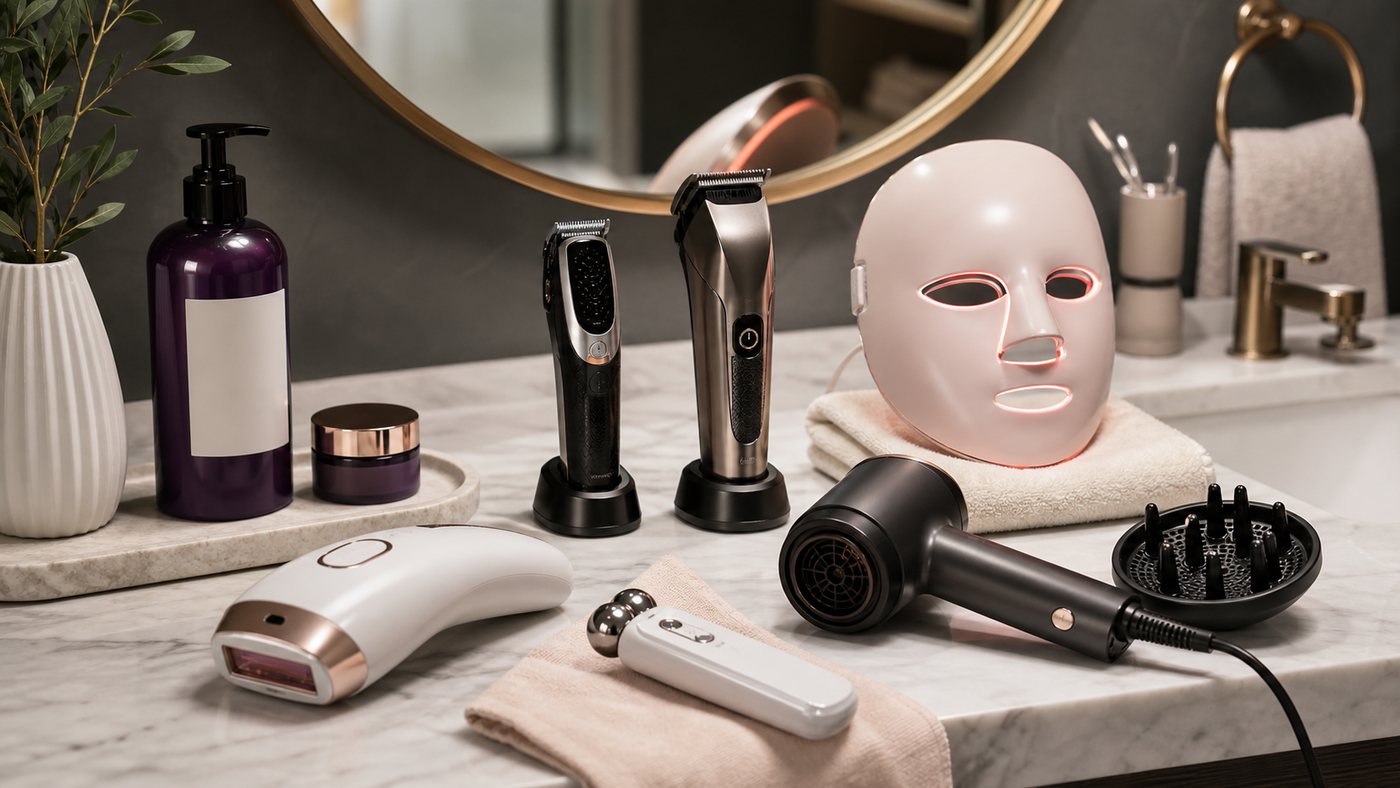
    Cinematic overview of men's beauty and personal care in 2026 — a well-groomed man surrounded by AI skin analysis, premium skincare, smart grooming tools, and sustainable eco-packaging


    Let’s be honest — the phrase “men’s beauty routine” would have made a lot of guys laugh or squirm not too long ago. But in 2026, that conversation has quietly become one of the most relevant and financially significant shifts in the global consumer market. The men’s grooming and personal care industry is now worth well over $100 billion worldwide, and it is growing fast. More importantly, the men driving this growth are not chasing vanity. They are investing in confidence, health, and self-respect.

    What has changed is the conversation itself. Modern men are treating skincare the same way they treat fitness or nutrition — as a fundamental part of performing at their best, both professionally and personally. And the products available to them in 2026 are, frankly, remarkable. From AI-powered skin diagnostic tools and microbiome-balancing serums to ultra-sustainable solid-format grooming kits, the options are better, smarter, and more results-driven than any previous generation has had access to.

    This article covers the major trends, innovations, and practical advice shaping men’s beauty and personal care in 2026. Whether you are just starting a skincare routine, looking to upgrade your grooming toolkit, or simply curious about where the industry is heading, this guide has what you need.

    A modern man applying a luxury serum in a sleek smart bathroom with AI-powered skin analysis mirror and premium grooming products on a marble counter


    1. The “Skinimalism” Revolution: Less Product, More Science

    One of the defining philosophies in men’s personal care in 2026 is skinimalism — the art of doing less, but doing it better. The era of overcrowded bathroom shelves stacked with a dozen single-purpose products is fading. Modern men are gravitating toward streamlined routines built around a small number of high-performance, multifunctional products that actually deliver measurable results.

    This is not minimalism for the sake of it. It is a scientifically driven recognition that over-cleansing, over-exfoliating, and layering too many active ingredients can actually harm the skin barrier rather than help it. The industry has responded by developing products that do the heavy lifting of an entire routine in a single, elegant formula.

    What Multifunctional Actually Means in 2026

    A well-formulated “all-in-one” product today might simultaneously deliver:

    • Hydration: Hyaluronic acid or next-generation polyglutamic acid to draw and lock in moisture without greasiness.
    • Sun Protection: Lightweight SPF 30–50 that feels like a serum, not a sunblock — finally cracking the longstanding barrier to daily sun protection among men.
    • Oil Control: Niacinamide or rice extract to regulate sebum, keeping skin matte throughout the day without stripping it dry.
    • Urban Defense: Pollution-neutralizing antioxidants like resveratrol, vitamin C, and bakuchiol that fight free radical damage from city air and blue light from screens.
    • Anti-Aging: Peptide complexes that support collagen synthesis, addressing fine lines and loss of firmness without aggressive retinoids that can irritate sensitive skin.

    The practical result? A morning routine that takes under three minutes but delivers the cumulative benefit of what used to require five separate products.


    2. The Microbiome: The Science Behind Skin Health You Actually Need to Know

    If there is one piece of skin science that every man should understand in 2026, it is the concept of the skin microbiome. Your skin is not just a barrier — it is a living ecosystem inhabited by trillions of bacteria, fungi, and other microorganisms. When this ecosystem is balanced, skin is resilient, calm, and naturally protected. When it is disrupted — by harsh surfactants, aggressive exfoliants, or overuse of antimicrobial ingredients — skin becomes inflamed, oily, dry, or prone to breakouts.

    The leading skincare brands of 2026 have built their entire product philosophy around protecting and enhancing this ecosystem rather than disrupting it. The key ingredients you will increasingly see in men’s grooming products are:

    Ingredient Type What It Does Why Men Should Care
    Prebiotics Feed beneficial bacteria on the skin’s surface Keeps the microbiome ecosystem balanced and reduces redness
    Probiotics Introduce beneficial live microbial cultures to the skin Calms inflammation, particularly useful post-shave
    Postbiotics Stabilized byproducts of fermentation (e.g., lactobacillus ferment) Strengthens skin barrier, longest-lasting and most stable of the three

    Research in 2026 is also exploring the fascinating “skin-brain axis” — the connection between specific microbial balances on the skin and psychological well-being. Early findings suggest that a healthy skin microbiome may correlate with reduced cortisol (stress hormone) levels and improved mood, linking skincare to mental wellness in a genuinely scientific way.


    3. AI-Powered Grooming: Technology That Actually Earns Its Place

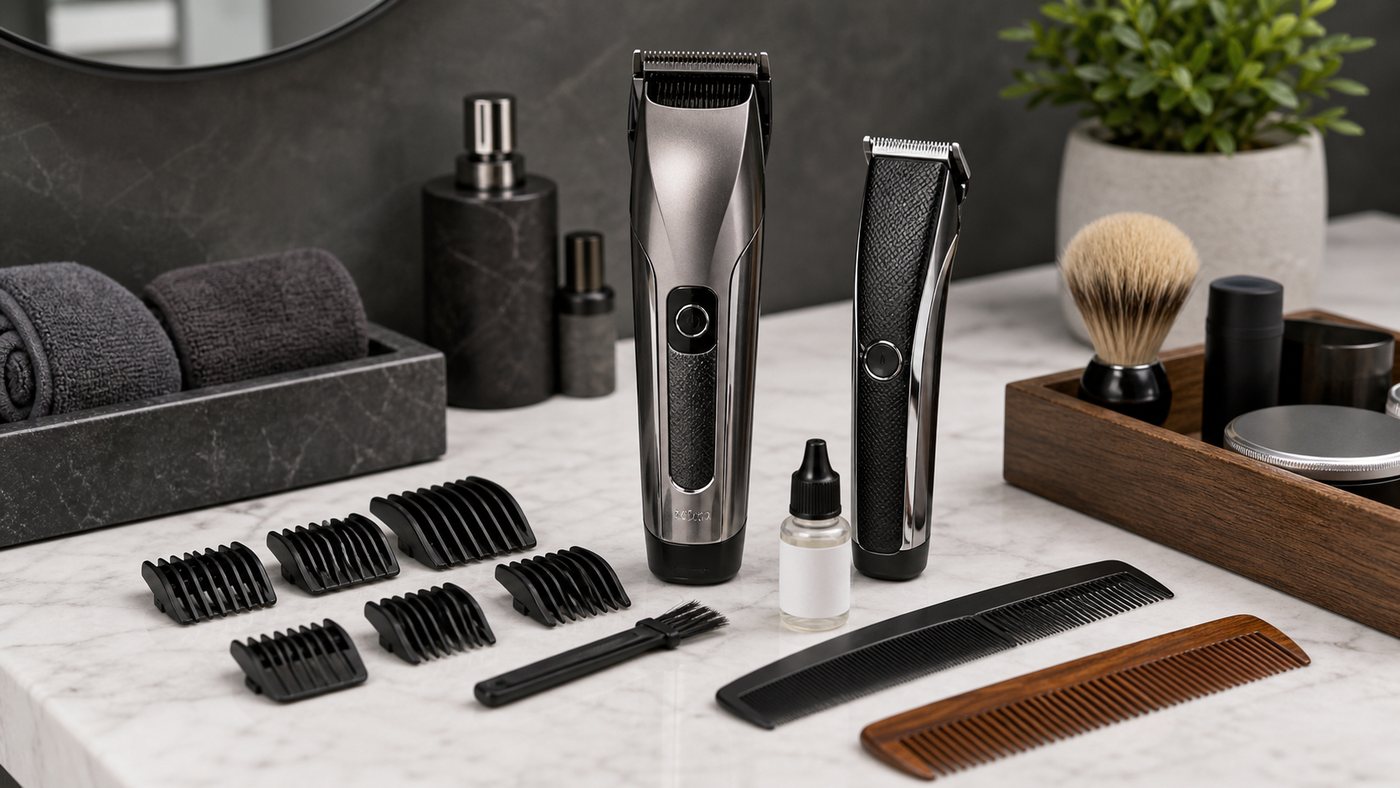
    Premium men's grooming flat-lay on dark slate featuring a smart electric razor, nanotech hair serum, eco-friendly refillable face wash, bamboo beard comb, jade roller, clay mask, and solid cologne

    Artificial intelligence has arrived in the men’s grooming aisle — and for once, the technology genuinely justifies the hype. In 2026, AI is doing real work in three distinct areas of men’s personal care: skin diagnostics, smart grooming devices, and personalized product recommendations.

    AI Skin Diagnostics: Your Personal Dermatologist in Your Phone

    Advanced AI imaging tools — some available as smartphone apps, others integrated into smart bathroom mirrors — can now analyze eleven or more skin attributes using a combination of visible light, UV fluorescence, and infrared imaging. In a matter of seconds, the system builds a detailed “digital skin map” showing:

    • Hydration levels across different facial zones
    • UV damage and hyperpigmentation below the surface (not yet visible to the naked eye)
    • Pore size, congestion, and distribution
    • Skin texture uniformity and firmness gradient
    • Signs of early chronic inflammation

    Based on this data, the AI generates a personalized routine recommendation — not based on your age and “skin type” in the old oversimplified sense, but based on the actual measurable condition of your skin on a given day. This is a genuinely transformative shift from one-size-fits-all product marketing to precision-calibrated personal care.

    Smart Grooming Devices: Tools That Think for You

    The smart razor of 2026 is almost incomprehensibly different from its predecessors. Devices equipped with sensor arrays and real-time adaptive technology can:

    • Adjust Motor Speed and Blade Tension: Based on the density and direction of your beard in real-time, preventing tugging on thick patches and reducing razor burn on sensitive areas.
    • Apply Optimal Pressure: Haptic feedback systems alert you when you are pressing too hard, significantly reducing nicks, ingrown hairs, and post-shave irritation.
    • Track Your Grooming Habits: Via a paired app, logging how your skin responds over time and recommending adjustments to technique or shaving frequency.
    • Self-Cleaning and Self-Lubricating: Reducing maintenance and ensuring hygienic operation with every use.

    For hair care, AI-integrated scalp devices use photobiomodulation (red and near-infrared light therapy) to stimulate hair follicle activity and deliver targeted heat to the scalp at clinically optimized wavelengths. The result: improved hair density and scalp health, administered in a fifteen-minute home session a few times a week.


    4. Hair and Scalp Care: The Frontier Men Are Finally Paying Attention To

    Hair care for men has historically been an afterthought — a quick shampoo and a blob of whatever gel was on sale. In 2026, this has changed dramatically. As men become more aware of the connection between scalp health and hair quality, and as the scientific community produces increasingly strong evidence for various interventions, the men’s haircare market has expanded significantly.

    Scalp-First Philosophy

    The new understanding is simple: healthy hair begins at the scalp. A congested, inflamed, or poorly balanced scalp environment will inevitably produce weaker, duller, and more thinning hair over time. The 2026 approach to hair care starts with the scalp as the primary target, with hair quality as the natural outcome.

    Products and treatments now include:

    • Microbiome-Balancing Scalp Serums: Prebiotic and postbiotic formulas that maintain a healthy scalp flora, reducing dandruff and flaking without the harsh antifungal chemicals that can cause dryness and rebound oiliness.
    • Nanotech Active Delivery: Nanoencapsulated active ingredients (such as minoxidil, peptides, or caffeine) that penetrate the scalp’s surface barrier to reach hair follicles directly — dramatically improving efficacy compared to traditional topical application.
    • Growth-Supporting Nutraceuticals: Supplement routines combining clinically studied ingredients (biotin, saw palmetto, keratin peptides, and specific zinc formulations) are now standard companion products to topical hair treatments.

    Haircut and Style Trends: Natural, Effortless, and Precise

    On the aesthetic side, the dominant hair trend of 2026 is natural texture with sharp precision. Men are moving away from the heavy pomade looks of the early 2020s in favor of styles that honor their natural hair movement — whether that means waves, curls, or straight strands — while maintaining crisp, clean lines at the nape and temples. The styling products enabling this look are:

    • Sea Salt Sprays: Lightweight, non-sticky texture enhancers that add natural-looking volume and movement.
    • Matte Clay and Fiber Pastes: Medium-hold, zero-shine finishes that look like you have well-groomed, naturally healthy hair rather than styled hair.
    • Washable Color Deposits: Tinted styling creams that subtly enhance or deepen natural hair color, adding dimension without commitment — a trend driven by younger men and increasingly adopted across age groups.

    5. Sustainable Grooming: The Shift to Eco-Intelligent Products

    A well-groomed stylish man on a forest trail at golden hour with a compact sustainable travel grooming kit on a log beside him, featuring solid shampoo bars, bamboo toothbrush, and natural skincare

    Sustainability in personal care is no longer a niche concern or a marketing buzzword — it is a purchasing criterion for a growing majority of consumers, including men. In 2026, the eco-intelligent grooming movement has matured from “we use some recycled plastic” to genuinely innovative, system-level solutions.

    Solid Format Products: The Future of the Bathroom

    The most impactful sustainability innovation in men’s personal care is the widespread mainstream adoption of solid-format products. What began as a niche natural-beauty trend has become fully engineered, high-performance technology:

    • Solid Shampoo Bars: Concentrated bars that last two to three times longer than an equivalent liquid bottle. Modern formulations are as effective as premium salon shampoos, sulfate-free, and available for all hair types including oily, dry, and color-treated.
    • Solid Face Wash Bars: Gentle, pH-balanced cleansing bars with microbiome-friendly surfactants. Nothing like the harsh soaps of decades past — these are effective cleansers that protect the skin barrier.
    • Solid Cologne: Alcohol-free wax or balm-format fragrances that apply directly to pulse points, last for hours, and eliminate the alcohol and aerosol propellant of traditional spray colognes. A genuinely compelling innovation for the travel-conscious man.
    • Solid Moisturizer Sticks: Compact, melt-on-contact formulas in twist-up packaging — zero plastic waste, zero pump mechanism, and perfectly portable for gym bags and carry-on luggage.

    Refill Systems and Digital Product Passports

    For those who prefer liquid formulations, 2026 has brought a significant infrastructure improvement: brand-operated refill stations in select retailers, allowing customers to bring their aluminum or glass bottles and refill them with premium formulas at a lower cost. Some brands also use subscription refill pouches — thin mylar sachets with near-zero environmental footprint.

    An exciting emerging technology is the Digital Product Passport (DPP) — an NFC chip or QR code embedded in the product packaging that allows you to instantly verify the product’s complete sustainability credentials: ingredient sourcing, carbon footprint of production, and end-of-life disposal instructions. This technology is a direct counter to vague “eco-friendly” marketing claims and represents a new era of radical transparency in personal care.


    6. Wellness Integration: When Personal Care Becomes Self-Care

    Perhaps the most culturally significant shift in men’s personal care in 2026 is the full integration of grooming with broader wellness practices. The boundary between “grooming” and “wellbeing” has effectively dissolved for a growing cohort of men who understand that how they look and how they feel are deeply interconnected.

    Fragrance as Mood Management

    The fine fragrance market for men has evolved well beyond “smelling good for someone else.” In 2026, men are selecting fragrances based on their psychoactive properties — their capacity to influence mood, focus, energy, or calm. Aromachology, the scientific study of how olfactory stimuli affect psychology, is now a legitimate input in fragrance development:

    • Focus Blends: Cedarwood, vetiver, and black pepper combinations to improve concentration during deep work sessions.
    • Stress Relief Blends: Bergamot, lavender, and sandalwood to activate the parasympathetic nervous system and reduce cortisol.
    • Energy Blends: Citrus-forward, mint-accented formulas that stimulate the sympathetic nervous system and improve alertness pre-workout.

    Supplements for Skin and Hair: The Inside-Out Approach

    The concept of “beauty from within” has moved from lifestyle magazine territory into evidence-based practice. Men are increasingly supplementing their topical routines with targeted oral formulations:

    • Marine Collagen Peptides: Hydrolyzed collagen that provides the amino acid building blocks the body uses to synthesize new collagen, improving skin elasticity and firmness from the inside.
    • Astaxanthin: A powerful carotenoid antioxidant with clinical evidence for reducing UV-induced skin damage and inflammation.
    • Adaptogens (Ashwagandha, Rhodiola): Botanical compounds that regulate the body’s stress response, with downstream effects on cortisol-related hair loss and stress-triggered skin flare-ups.
    • Omega-3 Fatty Acids: The evidence for omega-3s supporting skin barrier function, reducing inflammatory acne, and promoting scalp health is robust and well-established.

    The “Tweakment” Conversation

    It would be incomplete to discuss men’s beauty in 2026 without acknowledging the growing openness toward cosmetic procedures among men — what the industry calls “tweakments.” From botulinum toxin for forehead lines to hyaluronic acid filler for under-eye hollows, these minimally invasive procedures are no longer exclusively the domain of women or celebrities. The normalization is driven by younger generations, by the destigmatization of men’s wellness conversations generally, and by increasingly natural-looking results that simply make men look refreshed rather than “worked on.”

    The key principle here, as with all aspects of personal care, is informed intention. These procedures are best pursued with qualified medical professionals after thorough research, and should always serve the goal of enhancing natural confidence rather than chasing an artificial ideal.


    7. Building Your 2026 Men’s Grooming Routine: A Practical Starting Point

    With so much innovation happening simultaneously, it can be genuinely difficult to know where to begin. Here is a practical, tiered framework based on the time you are willing to invest and the outcomes you are most interested in achieving:

    ⚡ The 3-Minute Man (Fundamentals Only)

    • A gentle, pH-balanced face wash (morning and evening)
    • A multifunctional moisturizer with SPF 30+ (morning)
    • A basic lip balm with SPF
    • A quality shampoo for your hair type (3–4x per week)

    This alone puts you significantly ahead of most men. Consistency beats complexity every time.

    🔬 The Optimized Man (Results-Focused)

    • All of the above, plus:
    • A targeted serum (vitamin C in the morning, niacinamide or a peptide complex in the evening)
    • A weekly clay mask for deeper cleansing
    • A scalp serum (applied 3x per week, left on overnight)
    • An omega-3 supplement daily

    Expect visible improvements in skin clarity, texture, and firmness within 8–12 weeks of consistent use.

    🚀 The High-Performance Man (Full Stack)

    • All of the above, plus:
    • An AI skin diagnostic tool (app-based or smart mirror) to track progress and adapt routine
    • A smart grooming device (electric razor with SkinIQ or equivalent)
    • A red light scalp therapy device (3x per week, 15 minutes)
    • A collagen peptide + adaptogen supplement stack
    • A curated fragrance wardrobe (at least a focus, stress-relief, and energy option)
    • Annual check-in with a dermatologist or aesthetician

    This is a full wellness integration. The investment in time and money pays dividends in confidence, longevity, and performance.


    Conclusion: The Modern Man Takes Care of Himself — and That Is a Strength

    The most important thing to understand about men’s beauty and personal care in 2026 is that it is not about conforming to a new cultural expectation or chasing a particular aesthetic. It is about understanding that your skin, hair, and overall physical presentation are extensions of your health — and that taking care of them is an act of respect toward yourself and the people around you.

    The tools available in 2026 are extraordinary. AI diagnostics that give you the clarity of a dermatologist’s assessment at home. Microbiome-balancing formulas that work with your skin’s biology rather than against it. Sustainable, solid-format products that perform as well as their liquid predecessors without the environmental cost. Smart grooming devices that eliminate the guesswork from shaving, trimming, and scalp treatment.

    You do not need all of it. Start with the fundamentals — a clean face, moisturizer, SPF, and a consistent approach — and build from there based on your goals. The single most powerful principle remains the same in 2026 as it has always been: consistency beats complexity. A simple routine done every day will always outperform an elaborate routine done sporadically.

    The modern man who takes care of himself is not vain. He is disciplined, informed, and clear about the fact that looking and feeling your best is not a luxury. It is a standard.

  • Unleashed: The 2026 Guide to Next-Gen Outdoor Adventure Gear and Portable Power Stations

    Unleashed: The 2026 Guide to Next-Gen Outdoor Adventure Gear and Portable Power Stations

    Breathtaking mountain landscape at sunrise with a modern campsite featuring foldable solar panels, a portable power station, and ultralight adventure gear

    There is something deeply satisfying about disconnecting from the digital world, stepping into the wilderness, and testing yourself against the raw beauty of nature. But here is the quiet truth about modern adventure in 2026: disconnecting from civilization does not mean disconnecting from power. In fact, the most exciting revolution in the outdoor industry this year is not a new trail or a new national park—it is the technology that allows you to go further, stay longer, and live more comfortably in the backcountry than at any point in human history.

    The outdoor gear landscape of 2026 is defined by three converging forces: radical material science that makes gear lighter and tougher than ever before, portable power stations that have matured from clunky novelties into sleek, indispensable energy hubs, and a growing “work-from-anywhere” culture that blurs the line between a weekend camping trip and a productive workweek in the wild. Whether you are a thru-hiker counting every gram, an overlander building out a vehicle-based basecamp, or a remote professional who wants to take Monday morning meetings from a lakeside campsite, this guide covers the innovations, the gear, and the practical advice you need for 2026.


    1. The Material Revolution: Lighter, Tougher, and Greener Than Ever

    Beautiful flat-lay of modern 2026 outdoor adventure gear on a wooden cabin floor including a graphene jacket, ultralight shoes, titanium cookware, and satellite communicator

    If you picked up a high-end hiking jacket from 2020 and compared it to a 2026 model of similar price, you would be holding two fundamentally different products. The fabric science behind outdoor gear has undergone a generational leap. The goal is no longer simply “waterproof and breathable”—it is about creating adaptive, intelligent materials that respond to your body and the environment in real-time.

    Graphene-Infused Composites

    Graphene—a single layer of carbon atoms arranged in a hexagonal lattice—has moved from laboratory curiosity to mainstream outdoor application. In 2026, leading manufacturers are weaving graphene fibers into jacket shells, tent fabrics, and even backpack frames. The results are remarkable:

    • Strength-to-Weight Ratio: Graphene-infused fabrics are up to 200 times stronger than steel by weight, allowing manufacturers to use thinner materials without sacrificing durability. A hardshell jacket that weighed 450 grams in 2022 now weighs under 280 grams while offering superior tear resistance.
    • Thermal Conductivity: Graphene naturally distributes heat evenly across a surface. In a jacket lining, this means body heat is spread uniformly rather than creating hot spots and cold spots, resulting in a more comfortable and thermally efficient layer.
    • Antibacterial Properties: Graphene naturally inhibits bacterial growth, meaning your base layers and socks stay fresher for longer on multi-day trips—a genuine quality-of-life improvement on the trail.

    Bio-Synthetic Fabrics and PFC-Free Waterproofing

    The sustainability conversation in outdoor gear has matured beyond simple “made from recycled bottles” messaging. In 2026, the industry is pioneering genuinely novel bio-synthetic materials:

    • Mycelium Membranes: Several brands are now using membranes grown from mycelium (the root structure of mushrooms) as a natural, biodegradable waterproofing layer. These membranes offer comparable waterproofing to traditional ePTFE but decompose naturally at end-of-life.
    • Sugar-Cane Polyamides: Nylon derived from sugar cane rather than petroleum is now commercially available in outdoor apparel, significantly reducing the carbon footprint of production.
    • PFC/PFAS-Free DWR: The complete elimination of “forever chemicals” (PFAS) from Durable Water Repellent coatings is the gold standard of 2026. New silicone-based and plant-wax DWR treatments deliver excellent water beading without the environmental and health risks associated with traditional fluorocarbon coatings.

    Phase Change Materials (PCM): Clothing That Thinks

    Perhaps the most exciting wearable innovation is the integration of Phase Change Materials into active layers. PCM microcapsules are embedded directly into the fabric. When your body temperature rises during a steep climb, these capsules absorb excess heat and effectively “melt,” cooling you down. When you stop and rest, the capsules release that stored heat back into the fabric, warming you up. It is essentially a built-in thermostat for your clothing—no batteries, no electronics, just material science doing the heavy lifting.


    2. Portable Power Stations: The Beating Heart of the Modern Campsite

    Stunning mountain campsite at golden hour with a sleek portable power station on a rock, connected to string lights, a camping fridge, and foldable solar panels

    If adventure gear has had a material revolution, portable power stations have had a complete identity transformation. In 2026, these devices are no longer a niche product for preppers and tech enthusiasts. They are the central nervous system of any serious outdoor setup—powering everything from camping fridges and drone batteries to laptops, CPAP machines, and espresso makers.

    The LiFePO4 Standard

    The battery chemistry wars are effectively over. Lithium Iron Phosphate (LiFePO4) has won decisively and is now the industry standard for portable power stations. Here is why this matters to you as a buyer:

    Feature LiFePO4 (2026 Standard) NMC Li-Ion (Older Gen)
    Lifespan 3,000 – 6,000+ charge cycles (roughly 10+ years of daily use) 500 – 1,000 cycles
    Safety Extremely stable; virtually no risk of thermal runaway Higher risk under extreme heat or damage
    Weight Slightly heavier per Wh, but rapidly improving Lighter per Wh
    Charging Speed Full charge in under 60 minutes (wall outlet) Typically 2–4 hours
    Operating Temp Performs well in a wider temperature range Degrades faster in extreme cold or heat

    The practical takeaway: a LiFePO4 power station you buy today will likely outlast the vehicle you drive to the campsite. The investment horizon is measured in decades, not years.

    Hyper-Fast Charging and Solar Efficiency

    The charging speeds of 2026 power stations are genuinely astonishing. Top-tier models from brands like Anker, EcoFlow, and Jackery can achieve a full charge from a wall outlet in under 60 minutes. Some units hit 80% capacity in as little as 45 minutes. This completely changes the logistics of trip planning: you can plug in your station while packing the car and have a full battery before the trunk is loaded.

    Solar charging has also taken a massive leap forward. Dual MPPT (Maximum Power Point Tracking) solar controllers are now standard in mid-range and premium stations. These controllers independently optimize the energy harvest from two separate strings of solar panels, meaning your station charges efficiently even when one panel is partially shaded by a tree or angled differently. With 200W–400W portable solar panels now commonly available and foldable into a briefcase-sized package, achieving a full solar recharge in 4–6 hours of direct sunlight is entirely realistic.

    Right-Sizing Your Power: A Practical Guide

    One of the biggest mistakes first-time buyers make is over-buying capacity. A 3,000Wh beast is overkill for a weekend car camping trip and a genuine burden for anyone who needs to carry their power. Here is a practical breakdown:

    Weekend Car Camping (1–3 nights):

    Recommended: 500Wh – 1,000Wh

    Powers: Phone charging, LED camp lights, a small Bluetooth speaker, a portable fan, and a drone battery. Enough for the essentials without carrying unnecessary weight.

    Extended Basecamp or Family Camping (4–7 nights):

    Recommended: 1,000Wh – 2,000Wh

    Powers: A 12V camping fridge, multiple device charging, a laptop for evening entertainment or remote work, a CPAP machine, and LED string lights. Pair with a 200W solar panel for daily top-ups.

    Overlanding / Off-Grid Living / Home Backup:

    Recommended: 2,000Wh – 5,000Wh+

    Powers: A full-size portable fridge, an induction cooktop, a coffee maker, multiple laptops and monitors, power tools, and high-draw medical devices. Expandable battery modules allow you to scale capacity as needed.


    3. The Overlanding and Work-From-Anywhere Revolution

    Epic overlanding scene at sunset with a rugged SUV, rooftop tent, deployed solar panels, portable power station, and a person working on a laptop in a camping chair

    The explosion of overlanding culture in 2026 represents the ultimate convergence of outdoor adventure, portable power, and remote work technology. The modern overlander is not simply driving to a campground; they are building a self-sufficient, mobile basecamp that can operate independently for days or even weeks at a time.

    The Mobile Office in the Wild

    With the stabilization of hybrid and remote work models globally, a growing community of professionals are taking their offices on the road—literally. A well-equipped overlanding rig in 2026 includes:

    • Satellite Internet (Starlink Mini / Competitors): Compact, vehicle-mountable satellite dishes now provide reliable broadband internet in locations that have zero cellular coverage. This single technology has transformed remote mountaintops and desert mesas into viable workspaces.
    • Portable Power Station (2,000Wh+): The power backbone that keeps the satellite dish, laptop, monitor, and router running throughout the workday, replenished daily by solar panels.
    • Smart Power Management: App-controlled power stations allow the overlander to monitor real-time energy consumption on their phone, set charging schedules to align with peak solar hours, and receive low-battery alerts before reaching critical levels.

    Satellite Communication and Safety

    Beyond internet access, satellite communication has become a non-negotiable safety tool for any serious outdoor adventurer. In 2026, devices like the Garmin inReach and Apple’s satellite SOS features have been joined by a new generation of compact, affordable satellite messengers that offer:

    • Two-Way Messaging: Send and receive text messages from anywhere on Earth, even in deep canyons or dense forests.
    • Live GPS Tracking: Share your real-time location with family or an emergency response center.
    • Weather Forecasting: Receive localized, detailed weather forecasts directly to the device, critical for planning mountain summit attempts or river crossings.
    • SOS Integration: One-button emergency SOS that coordinates with professional search and rescue services globally.

    Digital Product Passports: Trust, Not Greenwashing

    A fascinating and highly welcome trend in 2026 is the rise of the Digital Product Passport (DPP). Embedded as an NFC chip or QR code in the product itself, a DPP allows you to scan your jacket, tent, or backpack with your phone and instantly access its complete supply chain history: where the raw materials were sourced, where the fabric was woven, what factory assembled the product, and its verified environmental certifications. This is a direct response to years of vague “eco-friendly” marketing claims and represents a genuine step toward radical transparency in the outdoor industry.


    4. Smart Gear and Connected Safety Systems

    The integration of smart technology into outdoor gear in 2026 is subtle, practical, and genuinely useful—a far cry from the gimmicky “smart water bottles” of earlier years. The focus is on technology that directly enhances safety, reduces decision fatigue, and extends your range in the backcountry.

    UV and Biometric Monitoring

    Modern outdoor watches and wearable sensors now provide real-time UV index monitoring calibrated to your specific skin type and altitude. At elevation, UV radiation can be dramatically more intense than at sea level, and prolonged exposure without awareness is a real risk. When your UV dose reaches a predetermined threshold, the device sends a gentle alert to apply sunscreen or seek shade—simple, but incredibly effective for preventing long-term skin damage during multi-day alpine treks.

    Inflatable and Rapid-Deploy Shelters

    Tent design has seen a quiet revolution. The traditional tent pole, which required careful threading, bending, and clipping, is being challenged by inflatable beam technology. Modern inflatable tents use high-pressure air chambers as structural supports. You pump them up with a compact hand pump or an electric pump powered by your portable power station, and the tent is standing in under two minutes. The beams are surprisingly rigid and handle wind loads effectively. For car campers and families, this eliminates one of the most frustrating aspects of camping setup.

    Advanced Water Filtration

    Water filtration in 2026 has moved beyond basic pump filters. Gravity-fed systems with hollow-fiber membranes and activated carbon now remove not only bacteria and protozoa but also viruses, heavy metals, and microplastics from virtually any water source. Some systems incorporate UV-C LED sterilization powered by a small rechargeable battery, offering hospital-grade water purification in a package that weighs under 300 grams. For thru-hikers and remote travelers, this means you can confidently drink from almost any stream or lake you encounter.


    5. Your 2026 Adventure Kit: A Practical Buying Framework

    With so many innovations hitting the market simultaneously, building your adventure kit can feel overwhelming. Here is a structured framework to help you prioritize your purchases based on the type of adventures you pursue most often:

    For the Ultralight Backpacker

    • Priority 1: A graphene-infused hardshell jacket under 300g with PFC-free DWR.
    • Priority 2: 3D-knit trail running shoes with a Vibram outsole for fast-and-light hiking.
    • Priority 3: A compact satellite communicator (under 100g) for safety.
    • Power: A small 300Wh–500Wh power bank is sufficient. Focus on weight savings.

    For the Car Camper / Family Adventurer

    • Priority 1: A 1,000Wh–1,500Wh LiFePO4 power station paired with a 200W foldable solar panel.
    • Priority 2: An inflatable tent for frustration-free setup and teardown.
    • Priority 3: A 12V camping fridge (powered by your station) to replace the messy, ice-melting cooler forever.
    • Power: This is your core investment. A quality power station transforms the comfort level of every trip.

    For the Overlander / Digital Nomad

    • Priority 1: A 2,000Wh+ expandable power station with dual MPPT solar input, paired with 400W+ of solar panels.
    • Priority 2: A vehicle-mounted satellite internet terminal for reliable remote work connectivity.
    • Priority 3: A modular roof rack and storage system for organized, weather-resistant gear management.
    • Power: This is your lifeline. Budget accordingly—your power station is arguably the most important piece of equipment you own.

    Conclusion: Adventure Without Compromise

    The outdoor industry in 2026 has answered a question that adventurers have been asking for decades: Can I have the freedom of the wilderness without sacrificing the comforts and connectivity of modern life? The answer, for the first time, is a resounding yes.

    Graphene jackets keep you warm and light. Bio-synthetic fabrics protect you without poisoning the planet. Portable power stations give you the energy to run a campsite fridge, charge a drone, and even host a video call from a mountaintop—all powered by the sun. And satellite communicators ensure that no matter how far off the grid you roam, help is always one button press away.

    The key to building your 2026 adventure kit is to start with the foundation—reliable power and reliable connectivity—and layer the specialized gear on top based on your personal adventure style. Invest wisely, buy gear that lasts a decade, and get out there. The mountains are waiting, and they have never been more accessible.

  • Healthspan over Lifespan: The Scientific and Cultural Revolution in Health, Wellness, and Longevity in 2026

    Healthspan over Lifespan: The Scientific and Cultural Revolution in Health, Wellness, and Longevity in 2026

    Sleek, modern longevity clinic in 2026 with biophilic design and a screen showing DNA and biological metrics

    For generations, the goal of modern medicine was remarkably simple: keep people alive for as long as possible. We measured success by average life expectancy, celebrating every incremental increase in chronological years. However, this approach led to an unintended consequence—an aging population spending their final decades managing multiple chronic illnesses, cognitive decline, and physical frailty. We succeeded in extending lifespan, but we failed to protect healthspan.

    In 2026, we are witnessing a profound cultural and scientific revolution. The focus has shifted decisively from “reactive sick-care” to “proactive life design.” The goal is no longer just to add years to our life, but to add vibrant, functional, and joyful life to our years. Longevity is no longer a fringe pursuit of silicon valley billionaires or a collection of unverified wellness hacks; it has matured into a rigorous, personalized science combined with a collective return to intuitive, human-centric living.

    Whether you are a busy remote professional looking to sustain high energy levels, or simply someone wanting to feel your best at every stage of life, understanding the wellness landscape of 2026 is key to building a resilient body and mind. Let’s explore the major shifts, technologies, and practices defining the future of health.


    1. The Biology of Longevity: Measuring and Optimizing Your Epigenetic Age

    One of the most empowering shifts in modern health is the realization that your genes are not your destiny. While your DNA acts as a biological blueprint, the field of **epigenetics**—how your lifestyle and environment influence how your genes are expressed—has taken center stage in 2026. We now understand that we have direct control over the rate at which we age.

    Chronological vs. Biological Age

    In 2026, we no longer define aging by the candles on a birthday cake. Instead, we measure **biological age**. Chronological age is simply the number of times you have traveled around the sun, while biological age measures the functional health of your cells and organs. Using advanced epigenetic clocks (which analyze DNA methylation patterns), clinicians and home-testing kits can tell you exactly how fast your body is aging on a cellular level. If you are 45 years old chronologically, but have a biological age of 38, your longevity protocols are working.

    Multi-Omics: The Death of One-Size-Fits-All Advice

    Generic wellness advice—like “eat less and move more”—has been replaced by extreme personalization. The medical-wellness industry in 2026 leverages **multi-omics**, which integrates three core datasets:

    • Genomics: Understanding your inherited genetic predispositions, such as how your body processes specific fats, vitamins, or detoxifies environmental compounds.
    • Microbiomics: Analyzing the trillions of bacteria living in your gut, which dictate everything from your immune system to your serotonin levels.
    • Metabolomics: Tracking real-time chemical markers in your blood, including hormones, inflammatory proteins, and metabolic indicators.

    By combining these datasets, AI-powered health platforms construct a highly specific blueprint unique to your biology, telling you exactly which foods to eat, which exercises to perform, and which specific supplements your body requires.

    Mitochondrial Health and clearing “Zombie” Cells

    At the cellular level, longevity in 2026 focuses heavily on two areas: mitochondrial optimization and senolytic therapies. Mitochondria are the power plants of your cells. As we age, mitochondrial efficiency drops, leading to chronic fatigue and systemic aging. Practices like heat exposure, high-intensity interval training (HIIT), and targeted compounds (such as NAD+ precursors like NMN or NR) are widely used to stimulate mitochondrial biogenesis—the creation of fresh, high-performing cellular energy centers.

    Simultaneously, the medical community has embraced **senolytics**. These are compounds designed to help the body clear out senescent cells—often referred to as “zombie cells.” These are damaged cells that refuse to die; instead, they linger in tissues, secreting inflammatory molecules that accelerate the aging of neighboring healthy cells. Clearing these zombie cells using natural senolytics (like fisetin and quercetin) or clinical therapies is proving to be a cornerstone of systemic rejuvenation.


    2. Rewriting Longevity for Women: The Hormonal Command Center

    Historically, longevity and medical research suffered from a massive blind spot: the vast majority of clinical trials were conducted on male subjects (both human and animal), assuming that female biology was identical except for reproductive functions. In 2026, this bias has been dismantled. The wellness industry has recognized that women require entirely different longevity protocols, centered around hormonal health.

    Ovarian Longevity as Systemic Health

    For women, the health of the ovaries is now understood to be the “command center” for overall longevity. Ovaries do not just manage fertility; they produce estrogen and progesterone, which protect the cardiovascular system, maintain bone density, regulate metabolism, and support cognitive health. The natural decline of these hormones during menopause is no longer viewed as something to simply endure, but as a critical physiological transition that requires active support.

    In 2026, personalized Hormone Replacement Therapy (HRT) using bioidentical hormones has become standard preventative medicine. By maintaining hormonal balance, women are able to protect their brain health, drastically reduce their risk of osteoporosis, and maintain metabolic flexibility well into their later decades.

    Cycle-Synced Lifestyle Design

    Even before menopause, younger women are embracing “cycle-syncing”—aligning their work, exercise, and diet with the phases of their menstrual cycle. Rather than pushing through the same intense workout routine every day, women adjust their training: performing high-intensity workouts during the follicular and ovulatory phases when estrogen is high, and transitioning to restorative yoga and mobility work during the luteal phase. This prevents burnout, protects thyroid function, and manages chronic stress levels.


    3. The Wearable Backlash: “Lazy Wellness” and Nervous System Regulation

    A peaceful indoor hot spring and Scandinavian sauna area with soft warm lighting, steam rising, and a person breathing deeply to regulate their nervous system

    For the past decade, wellness was synonymous with data optimization. People wore smart rings, fitness trackers, and continuous glucose monitors, obsessing over sleep scores, heart rate variability (HRV), and step counts. But by 2026, a major cultural shift has occurred. Consumers are experiencing “wearable fatigue” and a backlash against constant surveillance. The emerging trend is **”Lazy Wellness”** or intuitive recovery—prioritizing rest, joy, and emotional repair over strict data tracking.

    Parasympathetic Activation: Calming the Storm

    The core focus of mental wellness in 2026 is **Nervous System Regulation**. In our hyper-connected, fast-paced work environments, most professionals spend their days in a state of chronic sympathetic overdrive—the “fight or flight” response. This constant elevation of cortisol and adrenaline triggers low-grade systemic inflammation (sometimes called inflammaging), which accelerates biological aging.

    Rather than tracking stress metrics, people are prioritizing active parasympathetic activation—the “rest and digest” state. This is achieved through simple, non-wearable-dependent practices:

    The Vagus Nerve Connection: The vagus nerve is the highway of the parasympathetic nervous system, running from your brainstem down to your abdomen. Stimulating this nerve instantly slows your heart rate, lowers blood pressure, and calms the brain. In 2026, simple somatic exercises—such as box breathing, prolonged exhalations, cold water face immersion, and vocal humming—are practiced as regular daily habits to reset the nervous system between work meetings.

    Communal and Sensory Recovery

    Wellness has also transitioned from a solitary, app-driven practice to a social experience. We are seeing a massive resurgence in public bathing houses, social saunas, and active recovery circles. Instead of sitting alone in an infrared sauna blanket at home, people are gathering at bathhouses to experience contrast therapy (alternating between a hot Finnish sauna and a cold plunge pool) in a community setting. This social connection acts as a powerful buffer against loneliness, which research has shown is as detrimental to lifespan as smoking 15 cigarettes a day.


    4. Fueling Longevity: Nutrient Density, Gut Health, and Metabolic Control

    Bright, clean modern kitchen counter styled with functional foods including fermented foods, green smoothie, avocados, berries, and adaptogen jars

    The conversation around nutrition has undergone a massive evolution. In 2026, we have moved past restrictive diets, calorie deprivation, and low-fat fads. The focus is now on **nutrient density, metabolic flexibility, and microbiome diversity**.

    The Gut Microbiome as your Health Foundation

    Your gut is home to trillions of microbes that act as a complex metabolic organ. In 2026, gut health is recognized as the foundation of systemic wellness. A healthy microbiome produces short-chain fatty acids (SCFAs) like butyrate, which strengthen the gut barrier, reduce systemic inflammation, and communicate directly with the brain via the gut-brain axis to regulate mood and focus.

    Rather than relying on processed probiotic pills, the focus in 2026 is on **fermented foods and prebiotic fiber variety**:

    • Fermented Foods: Daily consumption of live, unpasteurized fermented foods (such as kefir, kimchi, sauerkraut, and kombucha) introduces a diverse array of beneficial bacterial strains to the gut.
    • The 30-Plant Rule: Aiming to eat 30 different species of plants per week (including vegetables, fruits, whole grains, nuts, seeds, and herbs). This variety provides the specific prebiotic fibers required to feed different beneficial bacterial strains, ensuring a robust, diverse microbiome.

    Metabolic Health and Glycation Management

    Stable blood sugar is one of the most critical markers of longevity. When blood sugar spikes repeatedly, excess glucose binds to proteins and fats in a process called **glycation**. This creates Advanced Glycation End-products (AGEs)—fittingly named, as they damage collagen, stiffen blood vessels, and accelerate wrinkles and organ aging.

    To manage metabolic health, the modern wellness approach does not suggest eliminating carbohydrates. Instead, it teaches **glucose ordering** and food pairing. Eating fiber and protein before carbohydrates significantly dampens the glucose spike of a meal. Additionally, incorporating light movement, like a 10-minute walk after meals, allows muscles to soak up glucose directly from the bloodstream, protecting your cells from glycation damage.

    Nutrition Term Why it Matters in 2026
    Nutrient Density Focusing on the concentration of micronutrients (vitamins, minerals, antioxidants) per calorie. High nutrient density supports cellular repair and protects against DNA damage.
    Metabolic Flexibility The body’s ability to easily switch between burning carbohydrates and burning fats for fuel. This maintains stable energy levels throughout the day without energy crashes.
    Adaptogens Natural substances (like Ashwagandha, Cordyceps, and Lion’s Mane) that help the body adapt to physical and mental stress, protecting the adrenal system.

    5. Step-by-Step Blueprint: Implementing 2026 Longevity Practices

    Optimizing your health does not require you to take 50 different supplements or spend hours in a clinical environment. By implementing a few foundational, scientifically backed habits, you can drastically improve your healthspan. Here is a practical blueprint to get started:

    Step 1: Baseline Diagnostics

    You cannot manage what you do not measure. Start by establishing a clear picture of your current biological state.

    • Get Comprehensive Blood Work: Request a panel that includes markers of chronic inflammation (hs-CRP), cardiovascular health (ApoB), metabolic health (HbA1c and fasting insulin), and nutrient status (Vitamin D3, B12, Magnesium).
    • Determine your Biological Age: Use a reputable home-testing kit to measure your DNA methylation patterns, giving you a baseline biological age to track your progress over time.

    Step 2: Prioritize Sleep Quality

    Sleep is the ultimate longevity drug. During deep sleep, your brain activates its glymphatic system to wash away metabolic waste, while your body performs crucial cellular repair.

    • Maintain a Consistent Schedule: Go to bed and wake up at the same time every day, even on weekends, to stabilize your circadian rhythm.
    • Optimize Your Sleep Sanctuary: Keep your bedroom cool (between 65°F and 68°F / 18°C and 20°C), pitch-black, and quiet. Use blackout curtains and white noise if necessary.

    Step 3: Nourish Your Gut & Metabolism

    Shift your eating habits toward supporting your microbiome and maintaining glycemic control.

    • Add Fermented Foods: Incorporate one serving of live fermented food (like kefir or kimchi) into your daily diet.
    • Practice Glucose Ordering: When eating a meal, consume your vegetables first, followed by proteins and fats, and save starches and sugars for last.
    • Walk Post-Meal: Step out for a brisk 10-minute walk after your largest meal of the day to clear glucose from your bloodstream.

    Step 4: Incorporate Contrast & Breathwork

    Train your nervous system to be resilient in the face of stress.

    • Contrast Therapy: If you have access, spend 15 minutes in a sauna followed by 2 minutes in a cold plunge pool twice a week to boost circulation and stimulate heat/cold shock proteins.
    • Daily Vagus Nerve Reset: Spend 5 minutes every afternoon practicing box breathing (inhale for 4 seconds, hold for 4, exhale for 4, hold for 4) to shift your body out of sympathetic flight-or-flight mode.

    Conclusion: The Art of Dynamic Living

    The longevity revolution of 2026 is ultimately a return to balance. It is a harmonious marriage between cutting-edge cellular science and ancient, intuitive health practices. We are realizing that to live longer, we do not need to turn ourselves into biological machines or live in sterile isolation. Rather, we need to support our body’s natural resilience, feed our microbiomes, calm our overstimulated nervous systems, and reconnect with our communities.

    Longevity is not about avoiding aging; it is about aging dynamically, maintaining your physical strength, cognitive clarity, and emotional joy at every age. By focusing on your healthspan today, you are investing in a future where you can continue to create, explore, and live fully. Your future self will thank you.

  • The Grand Convergence: How Smart Homes and Remote Work Redefined Living in 2026

    The Grand Convergence: How Smart Homes and Remote Work Redefined Living in 2026

    Sleek, ultra-modern Scandinavian-style home office in 2026 with smart ambient lighting, curved monitor, and minimalist desk

    For years, technology analysts spoke of the “home of the future” as a collection of disjointed gadgets: voice assistants that could play music, lightbulbs that changed colors on command, and smart refrigerators that theoretically knew when you were out of milk. But in 2026, the narrative has shifted fundamentally. The smart home is no longer a collection of novelties. It has evolved into a unified, proactive ecosystem that serves as the critical infrastructure for both daily living and professional life.

    As remote and hybrid work models have solidified into the standard operating procedure for global business, our homes have taken on a dual identity. They must simultaneously serve as a peaceful sanctuary for family life and a high-performance, distraction-free environment for professional output. The response to this challenge has been the Grand Convergence: a merging of consumer smart technology, enterprise-grade connectivity, localized artificial intelligence, and environmental health science to create the ultimate work-from-home (WFH) experience.

    In this deep-dive guide, we will explore the major smart home and remote work trends of 2026. We will look at how agentic AI, unified networking standards, and health-focused automations are transforming how we design our workspaces and live our lives—and how you can implement these technologies to elevate your own daily routine.


    1. The Intelligent WFH Sanctuary: Designing the Ultimate Productivity Space

    The days of working from a kitchen table or a cluttered corner in the bedroom are long gone. In 2026, remote workers design their offices as dedicated productivity sanctuaries. The technology within these spaces is designed to be invisible yet highly responsive, adjusting the ambient environment in real-time to match the worker’s cognitive needs and daily calendar.

    Circadian Lighting and Adaptive Environments

    One of the most significant breakthroughs in WFH design is the integration of dynamic, circadian lighting. We have known for years that lighting color temperature and intensity directly impact focus and energy levels. In 2026, smart home office lighting is completely automated to align with your biological clock and work schedule:

    • Morning Focus (8:00 AM – 11:30 AM): The system automatically adjusts overhead panels and desk light bars to a bright, cool white light (around 5,000K to 6,000K) at high intensity. This suppresses melatonin production and boosts cortisol, helping you wake up and tackle deep work blocks.
    • Afternoon Warmth (1:30 PM – 5:00 PM): As the day progresses, the lighting shifts to a softer, neutral white (around 3,500K to 4,000K) to maintain focus without causing the sensory fatigue associated with prolonged exposure to harsh blue light.
    • Evening Wind-Down (5:30 PM onwards): Once your work day ends, the office transition light switches to a warm, low-intensity amber (2,200K to 2,700K). This signals to your brain that it is time to transition from “employee” back to “homeowner,” facilitating a natural wind-down.

    Camera-Ready Meeting Automations

    Video conferencing remains the primary medium of professional connection, but the stress of preparing your workspace for a call is a thing of the past. In 2026, your home office integrates directly with your digital calendar and communication tools (such as Slack, Teams, or Zoom) to automate “Meeting Mode”:

    Real-World Scenario: It is 10:00 AM, and you have a client presentation. As the calendar event approaches, your smart desk lamp slowly turns on, angling a soft diffusive light toward your face to eliminate harsh shadows. Your primary computer monitors dim slightly to reduce glare, and the smart motorized blinds adjust to prevent backlighting. Outside your door, a small status light turns red, signaling to family members or roommates that you are active in a meeting. Once the call ends, the room smoothly transitions back to its standard focus setup.

    Ergonomic Automation

    Ergonomics in 2026 goes beyond static chairs and desks. Smart standing desks now use presence sensors and gentle prompts to encourage movement. Rather than forcing you to remember to stand, the desk communicates with your fitness wearables. If it detects that you have been sitting with a high heart rate or for more than 50 consecutive minutes, the desk will subtly adjust its height by a fraction of an inch to prompt you to shift your posture, or elevate to a standing position between scheduled meetings.


    2. The Agentic Core: How Matter 2.0 and Local AI Are Revolutionizing Connectivity

    Modern cozy living room with a person working on a laptop, warm ambient lighting, and a minimal wall-mounted smart home display showing predictive data

    Behind these seamless automation experiences is a massive shift in how smart home systems communicate and process data. The fragmented ecosystems of the early 2020s—where users had to manage separate apps for lighting, security, and climate control—have been replaced by a unified, intelligent framework powered by the **Matter protocol** and **local Edge AI**.

    The Maturation of the Matter Protocol

    The standard protocol for smart homes has reached absolute maturity in 2026. The newest iterations of Matter ensure that hardware compatibility is no longer an obstacle. A light sensor from one manufacturer, a smart blind controller from another, and a thermostat from a third all speak the same language locally. They communicate directly over a Thread mesh network without needing custom cloud integrations or proprietary bridges. For the remote worker, this translates to unmatched system reliability and sub-millisecond response times.

    The Rise of Local-First Edge AI

    Perhaps the most critical technological leap in 2026 is the transition from cloud-reliant AI services to **Local-First processing**. In previous years, every voice command or automation trigger had to travel to a remote server, process, and send a command back to the house. This introduced latency, relied on a stable internet connection, and raised massive privacy concerns—especially for remote workers handling sensitive corporate data.

    In 2026, high-performance smart hubs run local, lightweight Large Language Models (LLMs) directly on your home network. This provides three major advantages:

    Benefit How it Works in 2026
    Absolute Privacy Conversations, calendar schedules, and sensor logs are processed entirely inside the house. No audio snippets or video feeds are sent to external cloud servers, satisfying strict corporate compliance requirements.
    Zero-Latency Execution Because data does not travel to the cloud and back, commands execute instantly. You ask your assistant to “mute the background music and prepare the lighting for a client presentation,” and it happens in a fraction of a second.
    Offline Resilience If your primary internet service provider suffers an outage, the local AI agent, Matter sensors, and automation schedules continue to function perfectly. The home remains smart even when the cloud is unreachable.

    Intelligent Network Prioritization

    Remote workers cannot afford network lag, dropouts, or bandwidth starvation because someone else in the house is streaming high-resolution media or downloading a heavy file. Next-generation routers utilize localized AI to dynamically partition bandwidth. The router recognizes traffic patterns: it prioritizes video call packets, VPN connections, and active database transfers on WFH devices, while gently throttling background updates or entertainment traffic during working hours. When 5:00 PM hits, the bandwidth allocation shifts back to a balanced, household-wide profile.


    3. Holistic Well-Being: Air Quality, Climate, and Circadian Health

    One of the hidden dangers of remote work is the psychological and physical strain of spending long, uninterrupted hours in a single indoor environment. Without the natural breaks of a commute, walks to meetings, or stepping out for lunch, remote workers are highly susceptible to fatigue, eye strain, and poor air quality. The 2026 smart home approaches this holistically, actively monitoring and adjusting the home’s climate to optimize cognitive performance and long-term health.

    Active Air Quality Management and Cognitive Performance

    Did you know that high levels of Carbon Dioxide (CO2) in a closed room can degrade cognitive function by up to 50%? In a typical sealed home office, CO2 levels can easily spike past 1,200 parts per million (ppm) within two hours of closed-door meetings. This leads to that familiar mid-afternoon brain fog, sluggishness, and minor headaches.

    In 2026, smart indoor air quality monitors track CO2, volatile organic compounds (VOCs), and fine particulate matter (PM2.5) in real-time. If the CO2 level in your office climbs past 800 ppm, the system triggers the home’s ventilation system, such as an Energy Recovery Ventilator (ERV), to draw in fresh, filtered air from the outside while expelling stale indoor air. It does this quietly, ensuring the fan noise never disrupts your calls.

    Microclimate Zoning

    Traditional heating and cooling systems operate on a single thermostat, meaning you either heat the entire house or freeze in the office. Modern smart home designs employ motorized smart dampers and ambient temperature sensors to create distinct thermal microclimates. The system knows you are working in the office from 9 to 5, so it diverts conditioned air specifically to that room. This keeps you perfectly comfortable at your desk while reducing energy use in unoccupied areas of the house, like bedrooms or the living room.

    “By focusing climate control only on active WFH zones during the day, homeowners reduce their daily heating and cooling energy usage by up to 35%, proving that productivity and environmental sustainability can go hand-in-hand.”


    4. The Sustainable WFH Ecosystem: Smart Energy & Resilience

    Sleek, minimalist wall-mounted home battery storage system with a digital smart energy dashboard showing clean energy flow


    With remote work keeping computers, multi-monitor setups, network infrastructure, and climate control running all day, home energy bills have risen significantly. At the same time, grid stability has become a concern in many regions. The response in 2026 has been a massive surge in home microgrids and sustainable energy management.

    Home Microgrids and Battery Backups

    For a remote professional, a power outage isn’t just an inconvenience; it represents lost billable hours, missed meetings, and damaged credibility. Because of this, modern home designs integrate solar arrays with advanced battery storage systems. These battery walls act as intelligent home microgrids. They are designed to monitor grid health and transition instantly to battery power in the event of an outage. This transfer occurs in under 10 milliseconds—so fast that your desktop computer, mesh router, and active monitors never even flicker.

    AI-Driven Energy Arbitrage

    The energy systems of 2026 do more than just store power; they play the energy market to save you money. Through a process called **energy arbitrage**, the smart home’s central AI agent monitors real-time electricity rates from your utility provider and cross-references them with weather forecasts:

    1. Solar Generation: During peak daylight hours, the solar panels power your home office and charge the battery storage.
    2. Predictive Charging: If the weather forecast predicts a cloudy afternoon, the system charges the batteries during the early morning hours when grid rates are lowest.
    3. Grid Disconnection: During peak demand hours (typically late afternoon and early evening), when grid rates skyrocket, the smart home automatically disconnects from the grid, running the entire house off the stored battery power. This shields the homeowner from peak pricing structures.

    5. Step-by-Step Guide: Building Your 2026 Smart WFH Setup

    Building a modern, integrated environment does not require you to tear down your walls or spend a fortune overnight. The key is to build systematically, prioritizing the core infrastructure first and layering intelligent devices on top as your needs evolve. Here is a practical roadmap to get you started:

    Step 1: The Foundation (Network & Hub)

    Before buying any smart lights or sensors, you must ensure your network can handle the load. A weak network is the single most common cause of smart home failures.

    • Invest in a Wi-Fi 6E or Wi-Fi 7 Mesh System: This ensures dedicated wireless bands for your high-speed work devices, leaving the standard bands for smart home accessories.
    • Choose a Local Hub: Select a hub that emphasizes local control (such as a Home Assistant Green, Apple TV 4K with Thread, or a next-generation SmartThings hub). Avoid hubs that require an internet connection for basic automations.

    Step 2: Productivity & Lighting

    Once your network is stable, focus on the elements that directly impact your daily focus and meetings.

    • Install Matter-Certified Smart Lighting: Look for light strips and overhead bulbs that support dynamic color temperature adjustment.
    • Add a Smart Light Bar: A monitor-mounted light bar reduces eye strain by casting light downward onto your workspace without reflecting glare off your screen.
    • Integrate a Presence Sensor: A millimeter-wave (mmWave) presence sensor is far more accurate than standard motion sensors. It can detect you even if you are sitting perfectly still at your desk, ensuring your lights never turn off while you are reading a document.

    Step 3: Indoor Climate and Air Quality

    Focus on your physical comfort to protect your health during long work sessions.

    • Add a Dedicated Air Quality Monitor: Place a sensor on your desk at breathing height to monitor CO2 and PM2.5 levels.
    • Install Smart Vents or Dampers: Pair these with your thermostat to redirect airflow to your office space during working hours, ensuring your workspace remains comfortable without wasting energy on the rest of the house.

    Step 4: Resilience and Security

    Finally, build out the infrastructure that keeps you safe and online during emergencies.

    • Install a Smart UPS (Uninterruptible Power Supply): If a whole-house battery wall is out of your budget, place a dedicated UPS under your desk to power your router, modem, and primary computer. This guarantees you remain connected during sudden dropouts.
    • Implement Network Segmentation: Use your router to create a separate VLAN (Virtual Local Area Network) for your smart home devices. This isolates your IoT products from your work computer, keeping corporate data completely secure from potential smart home vulnerabilities.

    Conclusion: The Future is Responsive

    The transformation of the smart home in 2026 reflects a deeper shift in how we relate to technology. We are moving away from an era where we had to adapt to our gadgets, clicking through apps and configuring complex rules. Instead, we have entered the era of the responsive home—an environment that understands our context, respects our privacy, protects our health, and supports our productivity.

    By designing a workspace that integrates circadian lighting, local processing, clean air, and energy resilience, you aren’t just buying gadgets. You are investing in your professional output, your physical well-being, and a more balanced lifestyle. The smart home is no longer just a place to live; it is a partner in your career.

  • 5 Quietest Coffee Grinders for Early Mornings in 2026

    5 Quietest Coffee Grinders for Early Mornings in 2026

    Disclosure: As an Amazon Associate, I earn from qualifying purchases. This article includes affiliate links, which means I may earn a commission if you buy through them, at no extra cost to you.

    A peaceful morning kitchen scene with a sleek coffee grinder

    Browse quiet coffee grinder for early mornings on Amazon

    There is nothing quite like the ritual of brewing a fresh cup of coffee in the quiet solitude of the early morning. However, that peaceful tranquility is instantly shattered the moment you turn on a traditional coffee grinder. The screeching, high-decibel roar of coffee beans being pulverized can wake up sleeping spouses, frighten pets, and disturb neighbors through thin apartment walls.

    If you are an early riser who demands freshly ground beans but also values the peace of your household, you need a grinder specifically engineered for noise reduction. The quietest coffee grinders utilize lower RPM motors, heavy sound-dampening enclosures, and precision burrs to crush beans rather than violently shattering them. In this guide, we review the absolute best options for silent, stealthy morning brews.
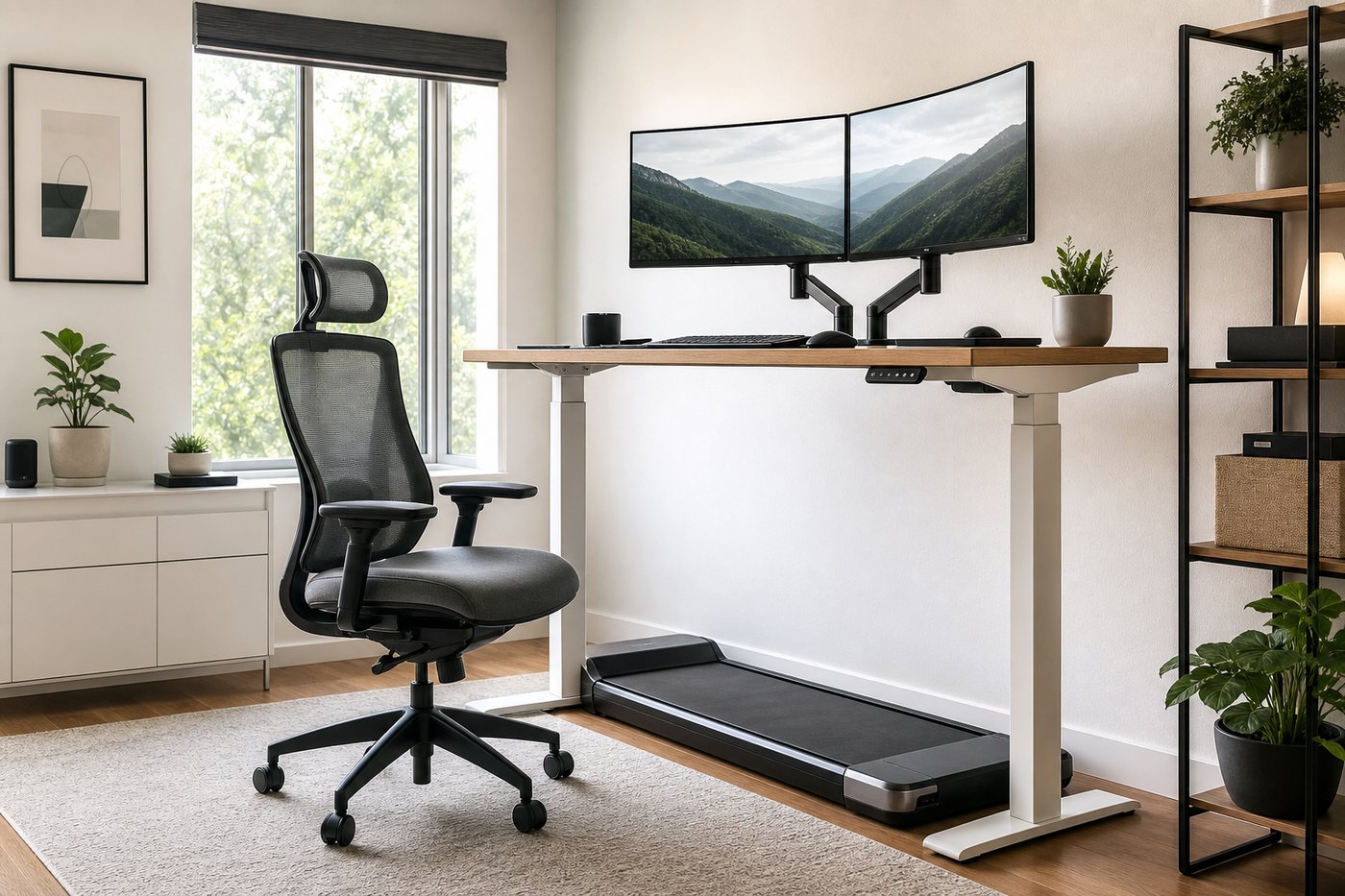

    Quick Comparison

    Product Best Feature Grind Type Link
    Eureka Mignon Silenzio Best Overall / Truly Silent Espresso to Drip Check Price
    Fellow Ode Brew Grinder Gen 2 Best for Pour Over & Filter Filter / Pour Over Check Price
    1Zpresso JX-Pro Manual Grinder The Ultimate Silent Option All Brew Methods Check Price
    Baratza Virtuoso+ Best Value Electric Burr All Brew Methods Check Price
    TIMEMORE Chestnut C2 Best Budget Silent Pick Filter / Aeropress Check Price

    1. Eureka Mignon Silenzio (Best Overall)

    If budget allows and you want the absolute quietest electric grinder on the market, the Eureka Mignon Silenzio is the ultimate choice. Hand-built in Florence, Italy, this grinder is a masterpiece of engineering, built specifically with noise reduction as its primary selling point.

    Why it’s perfect for early mornings:
    The name “Silenzio” translates to silence. Eureka uses a proprietary anti-vibration technology and a thick, heavy-duty metal casing that traps sound waves inside the machine. Instead of the high-pitched screech of standard grinders, the Silenzio produces a low, muffled hum that is barely audible from the next room. It features flat 50mm steel burrs that provide incredibly consistent grinds, particularly for espresso and fine drip.

    • Exclusive sound-dampening technology inside the casing.
    • Stepless micrometric adjustment for infinite grind settings.
    • Heavy build quality reduces vibration noise on countertops.
    • Produces a low hum rather than a high-pitched screech.

    View on Amazon

    2. Fellow Ode Brew Grinder Gen 2 (Best for Pour Over)

    The Fellow Ode is a stunning piece of modern kitchen tech. Designed specifically for brewed coffee (pour-over, French press, cold brew), it has quickly become a favorite among specialty coffee enthusiasts.

    Why it’s perfect for early mornings:
    The Ode Gen 2 was redesigned with a quieter motor and sound-dampening materials. Furthermore, it operates at a lower RPM (revolutions per minute) and uses massive 64mm flat burrs. Larger burrs mean the grinder finishes its job much faster, meaning even if it makes some noise, the duration is incredibly short. It also features an auto-stop function, turning off silently the moment the last bean is ground.

    • Large 64mm burrs grind beans incredibly fast, reducing noise time.
    • Lower RPM motor prevents high-pitched whining.
    • Auto-stop feature shuts off instantly when empty.
    • Stunning, minimalist aesthetic.

    View on Amazon

    3. 1Zpresso JX-Pro Manual Grinder (The Ultimate Silent Option)

    If you absolutely cannot make a sound, you must abandon electricity. A high-end manual hand grinder is the only 100% silent option. The 1Zpresso JX-Pro is widely considered the best hand grinder on the market for its price-to-performance ratio.

    Why it’s perfect for early mornings:
    There is no motor, no gears whining, and no electrical humming. The only sound is the incredibly satisfying, ASMR-like crunch of coffee beans being crushed between precision steel burrs. Thanks to its large 48mm burr set, you can grind 18 grams of coffee for a pour-over in about 30 seconds of easy turning. It will not wake a baby sleeping in the same room.

    • Essentially zero noise (only the soft crunch of beans).
    • Incredible grind consistency rivals $500 electric grinders.
    • Does not require electricity; perfectly portable.
    • Grinds remarkably fast for a hand grinder.

    View on Amazon

    4. Baratza Virtuoso+ (Best Value Electric)

    Baratza is a legendary name in home coffee equipment. While their entry-level Encore model is notorious for being quite loud, the upgraded Virtuoso+ features a different motor setup and a heavier metal chassis that noticeably dampens the sound.

    Why it’s perfect for early mornings:
    The metal base of the Virtuoso+ absorbs much of the motor vibration that usually transfers to your countertop (which acts like a speaker amplifier). It grinds at a relatively low RPM, giving it a lower, more tolerable pitch. It also grinds significantly faster than cheaper models, meaning the noise is over in seconds.

    • Metal chassis helps absorb motor vibrations.
    • Digital timer allows you to walk away while it grinds.
    • Excellent customer service and repairability from Baratza.
    • Great all-rounder for various brew methods.

    View on Amazon

    5. TIMEMORE Chestnut C2 (Best Budget Silent Pick)

    If you want the silence of a manual hand grinder but don’t want to spend over $150, the TIMEMORE C2 is the undeniable budget king. It changed the market for affordable hand grinders.

    Why it’s perfect for early mornings:
    Like the 1Zpresso, it is completely manual and operates with a quiet, soothing crunch. The C2 features sharp CNC stainless steel burrs that cut through beans with surprisingly little resistance. For less than $60, you get a grinder that is quieter and vastly superior in consistency to any cheap electric blade grinder on Amazon.

    • Extremely budget-friendly.
    • Completely silent operation (no motor noise).
    • Lightweight aluminum body with a premium feel.
    • Great for Aeropress and pour-over coffee.

    View on Amazon


    Buying Guide: What Makes a Grinder Quiet?

    Close-up of premium coffee beans in a burr grinder

    If you are shopping for a quiet coffee grinder, you need to look beyond marketing claims and check the actual specifications. Here is what truly dictates the volume of a grinder:

    1. Motor RPM (Revolutions Per Minute)

    Cheaper grinders use tiny, high-speed motors that spin at over 10,000 RPM. This creates a terrifying, high-pitched whining noise. High-end grinders use heavy-duty, low-RPM motors (around 400 to 1,500 RPM). They crush the beans slowly and steadily, producing a low, muffled hum that does not travel through walls.

    2. Burr Size

    The larger the burr, the more beans it can grind per rotation. A grinder with 64mm burrs will finish grinding your morning dose in half the time of a grinder with 38mm burrs. Less grinding time equals less noise time.

    3. Build Materials

    Weight is your friend. Cheap, thin plastic bodies act as resonance chambers, amplifying the sound of the motor. Premium grinders made from thick steel, aluminum, or heavy cast metal trap the sound waves inside. Furthermore, a heavy grinder will not vibrate against your kitchen counter.

    4. Burr Type (Flat vs Conical vs Blade)

    Never buy a blade grinder. They are essentially blenders that violently smash beans, creating the loudest, most obnoxious noise possible. Always choose a burr grinder. Flat burrs and conical burrs gently draw the beans in and crush them, which is significantly quieter.


    Frequently Asked Questions

    Are hand grinders really that quiet?
    Yes. They generate zero mechanical or motor noise. The only sound is the physical crushing of the beans, which is surprisingly soft and low-pitched. Most people find the sound relaxing.

    How can I make my current grinder quieter?
    If you don’t want to buy a new grinder, you can place a thick silicone mat or folded towel underneath your current grinder. This decouples it from the countertop, stopping the counter from acting like an amplifier for the motor vibrations.

    Why are quiet grinders usually more expensive?
    Sound-proofing requires heavy, premium materials like thick steel casings and sound-dampening gaskets. Additionally, low-RPM motors require more copper and higher-quality internal components than cheap, high-speed motors. You are paying for build quality.


    Conclusion

    Protecting the peace of your early mornings doesn’t mean you have to drink stale, pre-ground coffee. If you want the ultimate quiet electric experience, the Eureka Mignon Silenzio is a flawless investment that will last a lifetime. If you prefer the tactile experience and zero-decibel output of manual grinding, the 1Zpresso JX-Pro is an absolute joy to use. Enjoy your perfectly brewed coffee, and let your family sleep!

    Related kitchen organization guides